Get help with Social Studies, Grade 9
Most tutoring makes you sit through material you already know. MapleMind flips that: pick the exact skill that's causing trouble — any of the 43 below — and the tutor teaches just that one, step by step, as many times as it takes. Ask questions in plain words, any time of day, in English, French, or 12 other languages.
The official Newfoundland and Labrador Social Studies, Grade 9 curriculum
Newfoundland and Labrador defines Social Studies, Grade 9 by strands and outcomes. MapleMind teaches the same curriculum reorganized for one-skill-at-a-time tutoring — the table shows exactly where every official strand lands, and the ministry's own wording is quoted under each unit below.
Official source Newfoundland and Labrador's official curriculumRead it on the government site — gov.nl.ca ↗| Official strand | Outcomes | Where MapleMind teaches it |
|---|---|---|
| Strand 1 | 1 | Social Studies Concepts and Skills - 1. Inquiry and Research |
| Strand 2 | 2 | Anthropology - 2. Culture and Diversity |
| Strand 3 | 3 | Geography - 3. People, Place, and Environment |
| Strand 4 | 6 | History - 4. Time, Continuity, and Change |
| Strand 5 | 2 | History - 5. Interdependence |
| Strand 6 | 2 | Civics - 6. Citizenship, Power, and Governance |
| Strand 7 | 2 | Civics - 7. Time, Continuity, and Change |
| Strand 8 | 1 | Sociology - 8. Time, Continuity, and Change |
Every skill below, taught one on one.
 Try the first session free
How MapleMind teaches Social Studies, Grade 9 — every unit, lesson, and skill
Every skill below runs as a short session: a plain-words lesson, a worked example, solving it together, then a five-question skill check that earns up to three stars. Guided Mode keeps it teaching instead of answer-handing — turning it off needs a parent's password.
Unit 1Social Studies Concepts and Skills - 1. Inquiry and ResearchOfficial strand · Strand 1
Using inquiry, intellectual tools, and criteria-based reasoning to explore significant questions about Canadian identity.
Inquiry and Analysis
- Using an inquiry model and intellectual toolsNL-SS-9.1 — Use an inquiry model to explore significant questions and apply intellectual tools - use information, make comparisons, identify cause and consequence, consider perspective, determine significance, and make value judgements.
- Reasoning critically with criteriaNL-SS-9.1 — Make reasoned assessments based on appropriate criteria - thinking critically by weighing options and reaching reasonable conclusions.
The official wording — 1 outcome in this unit
- NL-SS-9.1
utilizing concepts and processes from the social sciences
Unit 2Anthropology - 2. Culture and DiversityOfficial strand · Strand 2
Introducing and consolidating the concept of Canadian identity through art, music, literature, and personal reflection.
Exploring Canadian Identity
- Canadian identity in art, music, and literatureNL-SS-9.2 — Analyse examples of art, music, and literature to identify the aspects of Canadian identity they contain, and compare how different artists represent it.
- A personal understanding of Canadian identityNL-SS-9.3 — Consolidate a year of learning into a personal understanding of Canadian identity, drawing on multiple sources and perspectives.
The official wording — 2 outcomes in this unit
- NL-SS-9.2
how various artistic expressions reflect Canadian identity
- NL-SS-9.3
their personal understanding of Canadian identity
Unit 3Geography - 3. People, Place, and EnvironmentOfficial strand · Strand 3
The physical and human geography of Canada and the story of migration to and within Canada since 1920.
The Physical Geography of Canada
- Canada's landform regionsNL-SS-9.4 — Identify Canada's eight landform regions and outline the geological forces - plate tectonics, mountain building, weathering, erosion, and deposition - responsible for its varied topography.
- Canada's climate regionsNL-SS-9.4 — Identify Canada's major climate regions and describe the global and regional factors - latitude, air masses, ocean currents, altitude, and bodies of water - that account for variations in climate.
The Human Geography of Canada
- Rural and urban settlementNL-SS-9.5 — Describe rural and urban communities using population density and distribution, and explain the site and situation factors that account for the growth and decline of settlements.
- Regional identities in CanadaNL-SS-9.5 — Explore Canada's regions - Atlantic Canada, Central Canada, the Prairies, British Columbia, and the North - and explain how physical and cultural factors shape regional identities and stereotypes.
Migration and Canada Since 1920
- Immigration to Canada since 1920NL-SS-9.6 — Explain push and pull factors of migration, how Canada's immigration patterns changed since the 1920s, and the ongoing debate over immigration and refugee policy.
- Internal migration and emigrationNL-SS-9.6 — Examine the causes and effects of internal migration and emigration since 1920, including the westward movement of Atlantic Canadians and the 'brain drain' to the United States.
The official wording — 3 outcomes in this unit
- NL-SS-9.4
the physical geography of Canada
- NL-SS-9.5
the human geography of Canada
- NL-SS-9.6
human migration and its impact on Canada since 1920
Unit 4History - 4. Time, Continuity, and ChangeOfficial strand · Strand 4
Canada in the 20th century - the 1920s and 1930s, the Second World War, the postwar decades, and Canada's role in world affairs.
The 1920s and 1930s
- Uneven prosperity in the 1920sNL-SS-9.7 — Explain why prosperity in the 1920s varied by region - growth in Central and Western Canada, decline in the Maritimes and the Dominion of Newfoundland - and did not extend to all groups.
- New technology and lifestyle in the 1920sNL-SS-9.7 — Examine how new technologies - electricity, cars, telephones, and appliances - and buying on credit changed lifestyle and culture in the 1920s.
- The Great DepressionNL-SS-9.7 — Explain the causes of the Great Depression, including the 1929 stock market crash, and describe its economic, social, and political effects on Canada.
Canada in the Second World War
- The causes of the Second World WarNL-SS-9.8 — Identify the broad causes of the Second World War - the terms of the Treaty of Versailles and the policy of appeasement.
- Canada's contribution to the warNL-SS-9.8 — Examine Canada's human and material contribution to the war - its greater autonomy under the Statute of Westminster, its decision to enter, and the role of its army, air force, navy, and merchant marine.
- Moral and ethical issues of the warNL-SS-9.8 — Examine significant moral and ethical issues of the war - the Holocaust and the use of atomic weapons - considering perspective and avoiding presentism.
The Second World War and Canadian Identity
- The war and ethnic and cultural relationsNL-SS-9.9 — Examine how the war affected ethnic and cultural relations in Canada - the refusal of Jewish immigrants, the internment of 'enemy aliens', and racism faced by African-Canadian and Indigenous volunteers.
The Postwar Decades
- Technology and economy in the 1950sNL-SS-9.10 — Explain how new technologies and postwar prosperity - transportation, communication, and domestic appliances - changed lifestyles in the 1950s, while poverty persisted for many.
- Changing values in the 1960s and 1970sNL-SS-9.11 — Explain why social values changed in the 1960s and 1970s - the rise of 'the teenager', the rejection of conservative norms, and the role of mass media and the CRTC.
- Movements and multiculturalismNL-SS-9.11 — Determine the significance of movements of the 1960s and 1970s - autonomy for First Nations and Inuit, civil rights, women's rights, and Trudeau's policy of multiculturalism.
Canada's Role in World Affairs Since 1945
- The Cold WarNL-SS-9.12 — Explain the causes and significance of the Cold War - the division into democratic/capitalist and communist camps and the ideology and events that drove the conflict.
- Canada in NATO, NORAD, and the UNNL-SS-9.12 — Examine Canada's participation in NATO, NORAD, and the United Nations, including the birth of UN peacekeeping and the controversies of these commitments.
The official wording — 6 outcomes in this unit
- NL-SS-9.7
economic, political and social change in Canada during the 1920s and 1930s
- NL-SS-9.8
Canada’s participation in the Second World War
- NL-SS-9.9
how the Second World War influenced Canadian identity
- NL-SS-9.10
the nature of change in Canada during the 1950s
- NL-SS-9.11
cultural and social change in Canada during the 1960s and 1970s
- NL-SS-9.12
Canada’s role in world affairs since 1945
Unit 5History - 5. InterdependenceOfficial strand · Strand 5
The effect of globalization on Canada since 1980, and the economic challenges and opportunities facing Canada's future.
Globalization and Canada Since 1980
- The concept of globalizationNL-SS-9.13 — Explain the concept of globalization and how it promotes interdependence, considering it in economic, political, and cultural terms and its strengths and weaknesses.
- The end of the Cold WarNL-SS-9.13 — Explain the causes and consequences of the end of the Cold War - Gorbachev's reforms, the dissolution of the USSR, and the changing roles of the UN, NATO, and NORAD.
- Economic globalizationNL-SS-9.13 — Explain the causes and consequences of economic globalization - production shifting to lower-cost countries, effects on Canadian jobs, and the role of transnational corporations.
- Globalization and cultureNL-SS-9.13 — Explain how globalization and mass communications influence culture and identity, including the dominance of western media and the emergence of a 'global culture'.
Canada's Economic Future
- Population trends and the economyNL-SS-9.14 — Describe Canada's population trends - birth rate, death rate, migration, and life expectancy - using population pyramids, and predict the economic consequences of an aging population.
- Resource management and sustainabilityNL-SS-9.14 — Determine the significance of resource management and depletion across sectors (energy, mining, forestry, farming, fishing) and propose solutions for sustainable development.
- Economic ties with the United StatesNL-SS-9.14 — Identify the benefits and limitations of increased economic union with the United States, examining Canada's trade relationship and its importance to both economies.
The official wording — 2 outcomes in this unit
- NL-SS-9.13
the effect of globalization on Canada since 1980
- NL-SS-9.14
economic challenges and opportunities that may affect Canada’s future
Unit 6Civics - 6. Citizenship, Power, and GovernanceOfficial strand · Strand 6
Citizenship in a liberal democratic society and the structure and operation of government in Canada's federal system.
Citizenship in a Democracy
- The concept of citizenship and identityNL-SS-9.15 — Explain the concept of citizenship - a legal member of a state with defined rights and obligations - and how being a Canadian citizen influences individual and national identity.
- Rights and active citizenshipNL-SS-9.15 — Explain the rights and responsibilities of Canadian citizens under the Charter of Rights and Freedoms - including official languages and Indigenous treaty rights - and the importance of active citizenship.
Government in Canada
- Levels and branches of governmentNL-SS-9.16 — Describe how government is organized in Canada - the federal, provincial, and municipal levels, the place and significance of First Nations and Inuit governments, and the executive, legislative, and judicial branches.
- The rule of law and electionsNL-SS-9.16 — Explain the function of the rule of law in Canadian society and describe the election process - political parties, the electoral process, and the formation of majority and minority governments.
The official wording — 2 outcomes in this unit
- NL-SS-9.15
the significance of citizenship in the context of liberal democratic society
- NL-SS-9.16
the structure and operation of government in Canada under a federal system
Unit 7Civics - 7. Time, Continuity, and ChangeOfficial strand · Strand 7
How citizenship has evolved over time, and the political challenges and opportunities that may affect Canada's future.
The Evolution of Citizenship
- The historical roots of citizenshipNL-SS-9.17 — Examine the historical milestones that shaped modern citizenship - the Code of Hammurabi, Athenian democracy, Roman law, the Magna Carta, and the American and French revolutions.
- Changing citizenship and global eventsNL-SS-9.17 — Explain how the idea of citizenship in Canada has changed over time and analyse the impact of contemporary global events - such as 9/11 and Canada's shifting international roles - on citizenship.
Canada's Political Future
- Indigenous autonomy and self-governmentNL-SS-9.18 — Examine issues related to Indigenous autonomy and self-government - the historic treaties, the Assembly of First Nations, constitutional recognition of First Nations, Inuit, and Metis, and recent land claims including the Innu Nation of Labrador.
- Quebec sovereigntyNL-SS-9.18 — Examine issues related to Quebec sovereignty - language and culture, the political history from the Quiet Revolution to the 1995 referendum, and Quebec's economic empowerment.
- Regional issues in CanadaNL-SS-9.18 — Examine regional economic and political issues in Canada - disparities in prosperity, transfer payments, and disputes such as the Churchill Falls deal and resource revenues.
The official wording — 2 outcomes in this unit
- NL-SS-9.17
how citizenship has evolved over time
- NL-SS-9.18
political challenges and opportunities that may affect Canada’s future
Unit 8Sociology - 8. Time, Continuity, and ChangeOfficial strand · Strand 8
The social and cultural challenges and opportunities that may affect Canada's future.
Canada's Social and Cultural Future
- Socioeconomic trendsNL-SS-9.19 — Analyse current socioeconomic trends - the changing workplace, standard of living, family structure, and social programs - and forecast challenges and opportunities for Canadian society.
- Cultural diversity and its futureNL-SS-9.19 — Examine the challenges and opportunities cultural groups may face as Canada changes - the scope of multiculturalism and issues such as discrimination and the loss of traditional culture and language.
- A preferred vision for CanadaNL-SS-9.19 — Consolidate your learning to articulate a preferred vision for Canada's future and the role citizens can play in achieving it.
The official wording — 1 outcome in this unit
- NL-SS-9.19
social and cultural challenges and opportunities that may affect Canada’s future
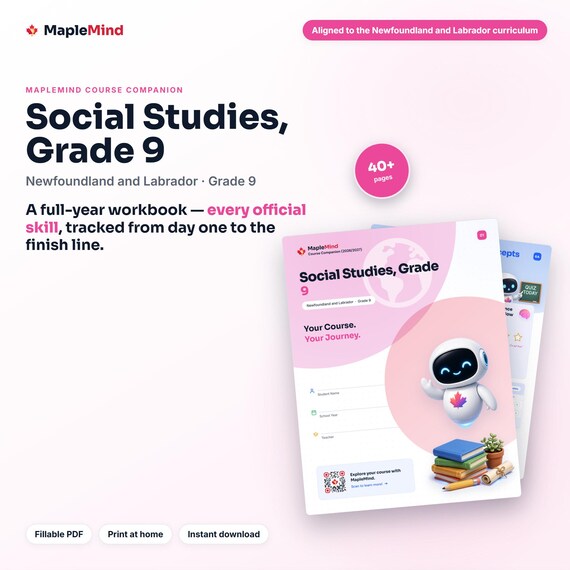
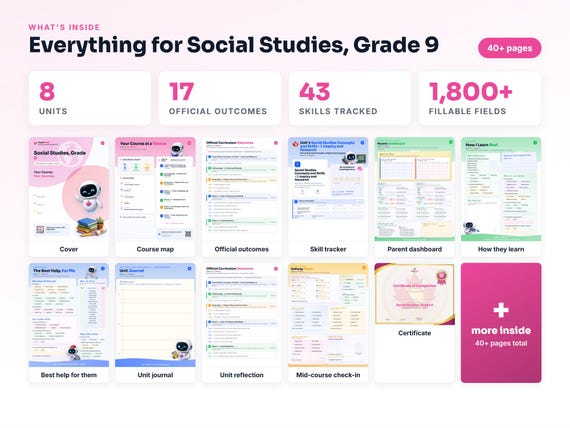
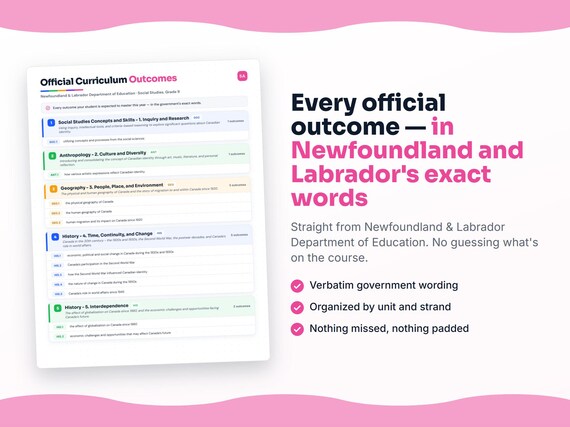

Printable workbook · A keepsake of the year
A Social Studies, Grade 9 workbook worth keeping
Built from the same official curriculum as this page. Before and after each skill above, your student colours in how sure they feel — so the two of you can see, on one page, what's clicking and what needs another look. It's a quiet way to follow how the year is really going.
By June it's full of their own handwriting: units worked through, confidence grown, a mid-year check-in, notes from parent-teacher night, and a certificate at the end. Less a worksheet, more a record of the year worth keeping on the shelf.
Instant download · see every page, reviews and the full description · five or more workbooks are $2.99 each
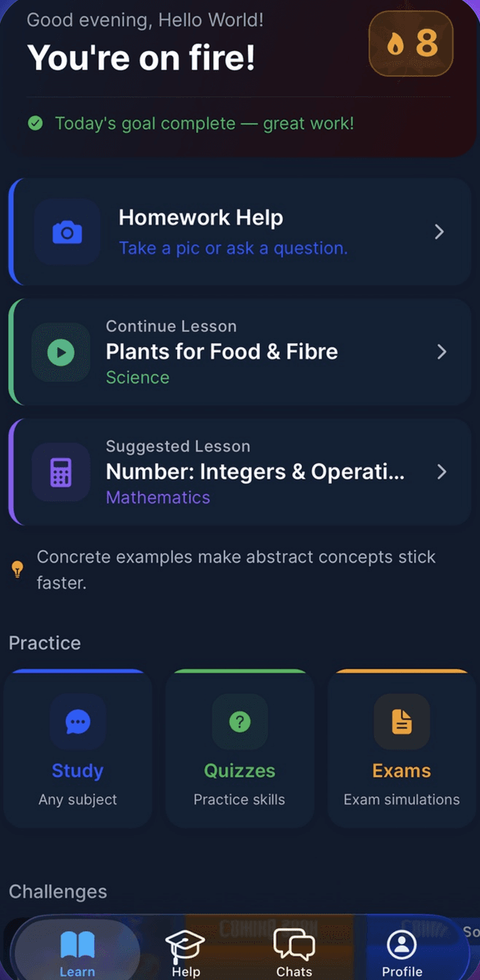
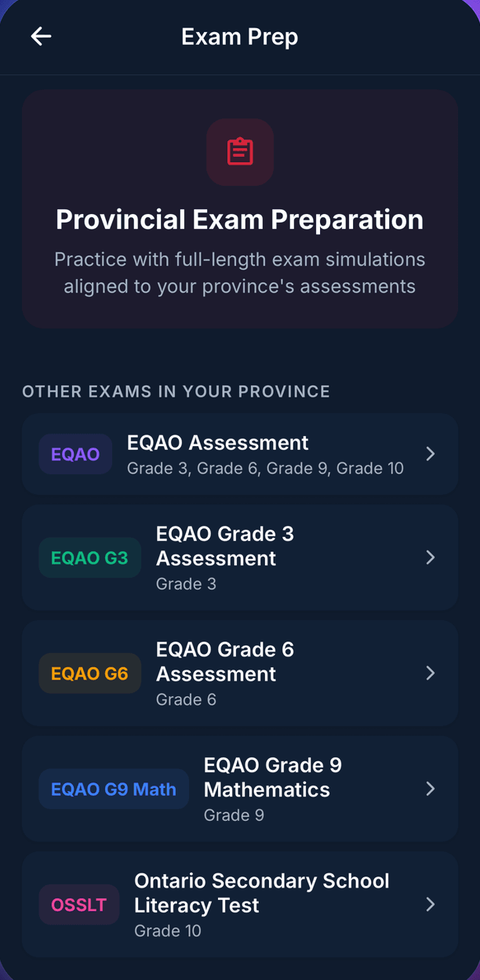
What it looks like in the app

Common questions
Can MapleMind help me with Social Studies, Grade 9?
Yes. MapleMind's AI tutor covers all 43 skills in Newfoundland and Labrador's Social Studies, Grade 9 — you pick the exact skill, and the tutor teaches it step by step: a short lesson, a worked example, solving together, then a skill check to show it stuck.
Is MapleMind aligned to Newfoundland and Labrador's official curriculum?
Yes. Every skill in this course maps to an official outcome code from Newfoundland and Labrador's Grade 9 Social Studies curriculum, and the ministry's own wording is quoted under each unit on this page — with the official government source linked so you can check it yourself.
What does MapleMind cost?
It's free to start — 5 tutoring chats and a practice quiz every day, no credit card. A Pro subscription ($9.99/month or $49.99/year CAD, 7-day free trial) unlocks unlimited tutoring, practice, and exam simulations.
What if I'm stuck on just one topic?
That's the point of skill-level tutoring: open Social Studies, Grade 9 in the app, tap the exact skill from the list on this page, and the tutor teaches just that — no wading through lessons you don't need.
Does MapleMind work in French or other languages?
Yes — 14 languages, including French. Both the app and the tutor's explanations switch to the language you choose.
Where can I see the official Newfoundland and Labrador curriculum for Social Studies, Grade 9?
The official source is linked on this page — Newfoundland and Labrador's official curriculum. The outline here follows it: every MapleMind skill carries its official outcome code, and the ministry's own wording is quoted under each unit.
Keep exploring
Ready when you are
Pick a skill from this page and see it taught properly — free, in the browser, in under a minute.