Get help with Social Studies, Grade 4
Most tutoring makes your child sit through material your child already knows. MapleMind flips that: pick the exact skill that's causing trouble — any of the 25 below — and the tutor teaches just that one, step by step, as many times as it takes. Ask questions in plain words, any time of day, in English, French, or 12 other languages.
The official Newfoundland and Labrador Social Studies, Grade 4 curriculum
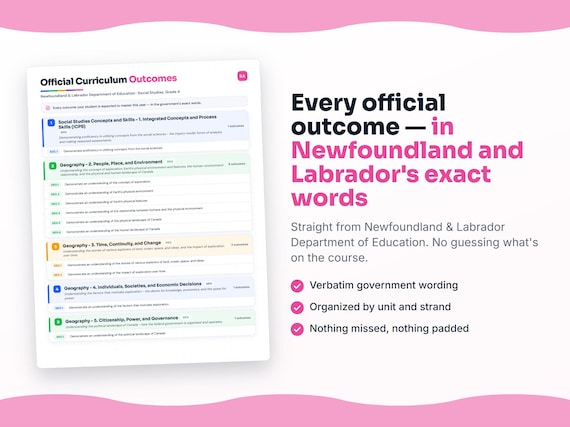
Newfoundland and Labrador defines Social Studies, Grade 4 by strands and outcomes. MapleMind teaches the same curriculum reorganized for one-skill-at-a-time tutoring — the table shows exactly where every official strand lands, and the ministry's own wording is quoted under each unit below.
Official source Newfoundland and Labrador's official curriculumRead it on the government site — gov.nl.ca ↗| Official strand | Outcomes | Where MapleMind teaches it |
|---|---|---|
| Strand 1 | 1 | Social Studies Concepts and Skills - 1. Integrated Concepts and Process Skills (ICPS) |
| Strand 2 | 6 | Geography - 2. People, Place, and Environment |
| Strand 3 | 2 | Geography - 3. Time, Continuity, and Change |
| Strand 4 | 1 | Geography - 4. Individuals, Societies, and Economic Decisions |
| Strand 5 | 1 | Geography - 5. Citizenship, Power, and Governance |
| Strand 6 | 1 | Geography - 6. Culture and Diversity |
Every skill below, taught one on one.
 Try the first session free
How MapleMind teaches Social Studies, Grade 4 — every unit, lesson, and skill
Every skill below runs as a short session: a plain-words lesson, a worked example, solving it together, then a five-question skill check that earns up to three stars. Guided Mode keeps it teaching instead of answer-handing — turning it off needs a parent's password.
Unit 1Social Studies Concepts and Skills - 1. Integrated Concepts and Process Skills (ICPS)Official strand · Strand 1
Demonstrating proficiency in utilizing concepts from the social sciences - the inquiry model, forms of analysis, and making reasoned assessments.
Inquiry and the Tools of Analysis
- Using an inquiry modelNL-SS-4.1 — Use an inquiry model to explore and resolve significant questions, from asking questions to presenting ideas.
- Forms of analysis and reasoned assessmentNL-SS-4.1 — Apply the social scientist's forms of analysis and make reasoned assessments based on appropriate criteria.
The official wording — 1 outcome in this unit
- NL-SS-4.1
Demonstrate proficiency in utilizing concepts from the social sciences
Unit 2Geography - 2. People, Place, and EnvironmentOfficial strand · Strand 2
Understanding the concept of exploration, Earth's physical environment and features, the human-environment relationship, and the physical and human landscape of Canada.
What Exploration Means
- Everyone is an explorerNL-SS-4.2 — Recognize that all people have experiences as explorers, and that exploration is distinct from 'discovery'.
- Types of explorationNL-SS-4.2 — Describe different types of exploration - of place, people, and ideas.
Earth's Physical Environment
- Identifying continents and oceansNL-SS-4.3 — Identify the seven continents and five oceans and use map concepts like hemisphere, equator, and prime meridian.
- Describing the continentsNL-SS-4.3 — Describe the continents in terms of their physical features, climate, and vegetation.
Earth's Physical Features
- Attributes of mountains, rivers, oceans, and islandsNL-SS-4.4 — Describe the attributes of Earth's major physical features - mountains, rivers, oceans, and islands.
- Examples of Earth's physical featuresNL-SS-4.4 — Identify national and global examples of each of Earth's major physical features.
Humans and the Physical Environment
- Benefits the environment offers humansNL-SS-4.5 — Describe the benefits the physical environment offers humans in meeting needs and wants.
- Challenges the environment posesNL-SS-4.5 — Describe the challenges the physical environment poses to humans.
- Human impact on the environmentNL-SS-4.5 — Explain the impact that human activity has on the physical environment.
The Physical Landscape of Canada
- The concept of regionNL-SS-4.6 — Explain the concept of region as an area sharing common characteristics, used by geographers to organize place.
- Canada's physical regionsNL-SS-4.6 — Describe Canada's six physical regions in terms of topography, climate, vegetation, and resources.
The Human Landscape of Canada
- Population patterns across CanadaNL-SS-4.7 — Explain population patterns across Canada, including density and the concentration of population in the south.
- Factors that influence where people liveNL-SS-4.7 — Explain some of the factors that influence where people live in Canada.
The official wording — 6 outcomes in this unit
- NL-SS-4.2
Demonstrate an understanding of the concept of exploration
- NL-SS-4.3
Demonstrate an understanding of Earth's physical environment
- NL-SS-4.4
Demonstrate an understanding of Earth's physical features
- NL-SS-4.5
Demonstrate an understanding of the relationship between humans and the physical environment
- NL-SS-4.6
Demonstrate an understanding of the physical landscape of Canada
- NL-SS-4.7
Demonstrate an understanding of the human landscape of Canada
Unit 3Geography - 3. Time, Continuity, and ChangeOfficial strand · Strand 3
Understanding the stories of various explorers of land, ocean, space, and ideas, and the impact of exploration over time.
The Stories of Explorers
- How we learn about explorersNL-SS-4.8 — Examine how we learn about explorers through primary and secondary sources, remembering that 'explored' lands were often already inhabited.
- Challenges explorers faced and metNL-SS-4.8 — Identify challenges explorers faced and explain how they met them.
The Impact of Exploration
- How exploration changes understandingNL-SS-4.9 — Explain how exploration changes our understanding of the world.
- Evaluating the consequences of explorationNL-SS-4.9 — Evaluate the consequences of exploration - both beneficial and harmful.
The official wording — 2 outcomes in this unit
- NL-SS-4.8
Demonstrate an understanding of the stories of various explorers of land, ocean, space, and ideas
- NL-SS-4.9
Demonstrate an understanding of the impact of exploration over time
Unit 4Geography - 4. Individuals, Societies, and Economic DecisionsOfficial strand · Strand 4
Understanding the factors that motivate exploration - the desire for knowledge, economics, and the quest for power.
Why People Explore
- Desire for knowledgeNL-SS-4.10 — Explain how the desire for knowledge motivates exploration.
- EconomicsNL-SS-4.10 — Explain how economics motivates exploration.
- The quest for powerNL-SS-4.10 — Explain how the quest for power motivates exploration.
The official wording — 1 outcome in this unit
- NL-SS-4.10
Demonstrate an understanding of the factors that motivate exploration
Unit 5Geography - 5. Citizenship, Power, and GovernanceOfficial strand · Strand 5
Understanding the political landscape of Canada - how the federal government is organized and operates.
How Canada Is Governed
- How the federal government is organizedNL-SS-4.11 — Explain how Canada's federal government is organized, including provinces and territories, Ottawa, and the roles of MPs, the House of Commons, Prime Minister and Cabinet, and Senate.
- How the federal government operatesNL-SS-4.11 — Explain how Canada's federal government operates in debating issues and making laws.
The official wording — 1 outcome in this unit
- NL-SS-4.11
Demonstrate an understanding of the political landscape of Canada
Unit 6Geography - 6. Culture and DiversityOfficial strand · Strand 6
Understanding symbols associated with Canada's landscapes - the official and unofficial symbols of Canada and proposing new ones.
The Symbols of Canada
- Official and unofficial symbols of CanadaNL-SS-4.12 — Explain the significance of Canada's official and unofficial symbols and provide a rationale for other symbols that could represent Canada.
The official wording — 1 outcome in this unit
- NL-SS-4.12
Demonstrate an understanding of symbols associated with Canada's landscapes
Printable workbook · A keepsake of the year
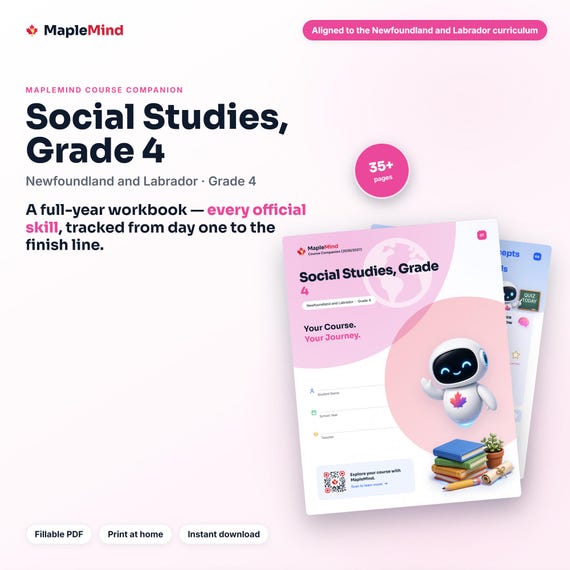
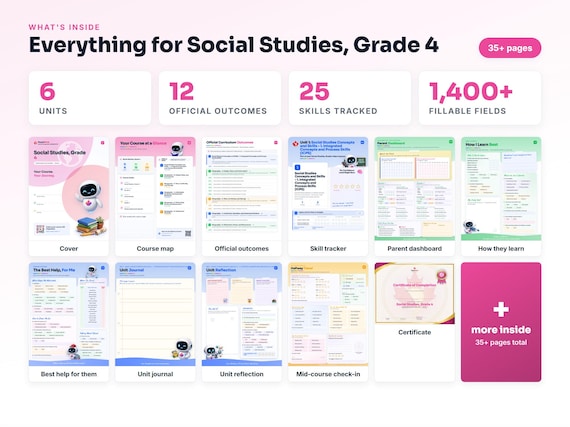
A Social Studies, Grade 4 workbook worth keeping
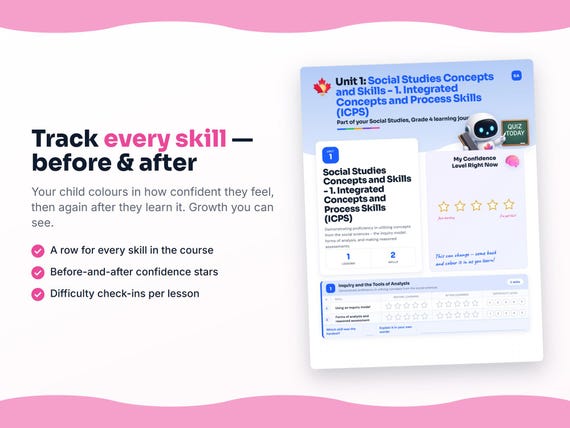
Built from the same official curriculum as this page. Before and after each skill above, your student colours in how sure they feel — so the two of you can see, on one page, what's clicking and what needs another look. It's a quiet way to follow how the year is really going.
By June it's full of their own handwriting: units worked through, confidence grown, a mid-year check-in, notes from parent-teacher night, and a certificate at the end. Less a worksheet, more a record of the year worth keeping on the shelf.
Instant download · see every page, reviews and the full description · five or more workbooks are $2.99 each
What it looks like in the app



Common questions
Can MapleMind help my child with Social Studies, Grade 4?
Yes. MapleMind's AI tutor covers all 25 skills in Newfoundland and Labrador's Social Studies, Grade 4 — your child picks the exact skill, and the tutor teaches it step by step: a short lesson, a worked example, solving together, then a skill check to show it stuck.
Is MapleMind aligned to Newfoundland and Labrador's official curriculum?
Yes. Every skill in this course maps to an official outcome code from Newfoundland and Labrador's Grade 4 Social Studies curriculum, and the ministry's own wording is quoted under each unit on this page — with the official government source linked so you can check it yourself.
What does MapleMind cost?
It's free to start — 5 tutoring chats and a practice quiz every day, no credit card. A Pro subscription ($9.99/month or $49.99/year CAD, 7-day free trial) unlocks unlimited tutoring, practice, and exam simulations.
What if my child is stuck on just one topic?
That's the point of skill-level tutoring: open Social Studies, Grade 4 in the app, tap the exact skill from the list on this page, and the tutor teaches just that — no wading through lessons your child doesn't need.
Does MapleMind work in French or other languages?
Yes — 14 languages, including French. Both the app and the tutor's explanations switch to the language your child chooses.
Where can I see the official Newfoundland and Labrador curriculum for Social Studies, Grade 4?
The official source is linked on this page — Newfoundland and Labrador's official curriculum. The outline here follows it: every MapleMind skill carries its official outcome code, and the ministry's own wording is quoted under each unit.
Keep exploring
Ready when you are
Pick a skill from this page and see it taught properly — free, in the browser, in under a minute.