Get help with English Language Arts, Grade 1
Most tutoring makes your child sit through material your child already knows. MapleMind flips that: pick the exact skill that's causing trouble — any of the 33 below — and the tutor teaches just that one, step by step, as many times as it takes. Ask questions in plain words, any time of day, in English, French, or 12 other languages.
The official Newfoundland and Labrador English Language Arts, Grade 1 curriculum
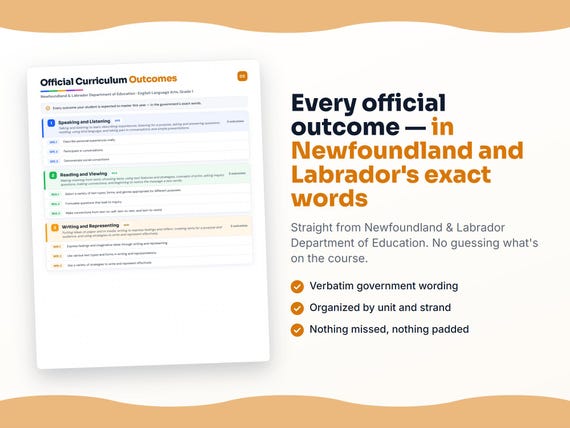
Newfoundland and Labrador defines English Language Arts, Grade 1 by strands and outcomes. MapleMind teaches the same curriculum reorganized for one-skill-at-a-time tutoring — the table shows exactly where every official strand lands, and the ministry's own wording is quoted under each unit below.
Official source Newfoundland and Labrador's official curriculumRead it on the government site — gov.nl.ca ↗| Official strand | Outcomes | Where MapleMind teaches it |
|---|---|---|
| Strand SL | 16 | Speaking and Listening |
| Strand RV | 11 | Reading and Viewing |
| Strand WR | 6 | Writing and Representing |
Every skill below, taught one on one.
 Try the first session free
How MapleMind teaches English Language Arts, Grade 1 — every unit, lesson, and skill
Every skill below runs as a short session: a plain-words lesson, a worked example, solving it together, then a five-question skill check that earns up to three stars. Guided Mode keeps it teaching instead of answer-handing — turning it off needs a parent's password.
Unit 1Speaking and ListeningOfficial strand · Strand SL
Talking and listening to learn: describing experiences, listening for a purpose, asking and answering questions, retelling, using kind language, and taking part in conversations and simple presentations.
Explore, extend, clarify and reflect
- Describing your own experiences out loudNL-ELA-1.1.1 — Describe personal experiences out loud so listeners can picture what happened.
- Listening for different reasonsNL-ELA-1.1.2 — Listen in different situations for different purposes, such as to enjoy a story or to follow along.
- Asking questions to learn moreNL-ELA-1.1.3 — Ask questions to find out more information about a topic, story, or activity.
- Answering questions to make things clearNL-ELA-1.1.4 — Respond to questions to clarify information for a listener.
- Retelling events and stories in orderNL-ELA-1.1.5 — Retell events and familiar stories in the correct sequence.
- Using aspects of language when speakingNL-ELA-1.1.6 — Use aspects of language such as tone and expression when speaking.
- Thinking about the oral texts you hearNL-ELA-1.1.7 — Reflect upon a variety of oral texts such as stories, songs, and talks.
Communicate and respond
- Taking part in conversationsNL-ELA-1.2.1 — Participate in conversations by taking turns and staying on topic.
- Sharing out loud in front of othersNL-ELA-1.2.2 — Present orally to a small group or the class.
- Sharing your own thoughts and opinionsNL-ELA-1.2.3 — Respond personally to information, ideas, and opinions by sharing your own reaction.
- Thinking carefully about ideas and opinionsNL-ELA-1.2.4 — Respond critically to information, ideas, and opinions by beginning to ask if they make sense.
- Giving directions with more than two stepsNL-ELA-1.2.5 — Communicate directions with more than two steps in the right order.
- Following directions with more than two stepsNL-ELA-1.2.6 — Follow directions with more than two steps in the right order.
Interact with sensitivity and respect
- Understanding how words affect feelingsNL-ELA-1.3.2 — Show an understanding of how word choice affects the feelings of others.
- Matching your voice and body to the situationNL-ELA-1.3.3 — Use verbal and non-verbal cues suitable for specific situations, audiences, and purposes.
The official wording — 16 outcomes in this unit
- NL-ELA-1.1.1
Describe personal experiences orally
- NL-ELA-1.1.2
Listen in a variety of situations for different purposes
- NL-ELA-1.1.3
Ask questions to seek more information
- NL-ELA-1.1.4
Respond to questions to clarify information
- NL-ELA-1.1.5
Retell events and familiar stories in sequence
- NL-ELA-1.1.6
Use aspects of language
- NL-ELA-1.1.7
Reflect upon a variety of oral texts
- NL-ELA-1.2.1
Participate in conversations
- NL-ELA-1.2.2
Present orally
- NL-ELA-1.2.3
Respond personally to information, ideas, and opinions
- NL-ELA-1.2.4
Respond critically to information, ideas, and opinions
- NL-ELA-1.2.5
Communicate directions with more than two steps
- NL-ELA-1.2.6
Follow directions with more than two steps
- NL-ELA-1.3.1
Demonstrate social conventions
- NL-ELA-1.3.2
Show an understanding of how word choice affects the feelings of others
- NL-ELA-1.3.3
Use verbal and non-verbal cues suitable for specific situations, audiences, and purposes
Unit 2Reading and ViewingOfficial strand · Strand RV
Making meaning from texts: choosing texts, using text features and strategies, concepts of print, asking inquiry questions, making connections, and beginning to notice the message a text sends.
Select, read and view a range of texts
- Choosing texts for a purposeNL-ELA-1.4.1 — Select a variety of text types, forms, and genres appropriate for different purposes.
- Using text features to understandNL-ELA-1.4.2 — Use text features before, during, and after reading to help construct meaning.
- Using strategies to make sense of textsNL-ELA-1.4.3 — Use strategies to make sense of texts, such as looking at pictures, sounding out, and rereading.
- Showing how print worksNL-ELA-1.4.4 — Demonstrate concepts of print such as reading left to right, top to bottom, and knowing where a word begins and ends.
Inquiry
- Making questions that lead to inquiryNL-ELA-1.5.1 — Formulate questions that lead to inquiry about a topic.
- Finding answers in different sourcesNL-ELA-1.5.2 — Use information from a variety of sources to seek answers to questions.
Respond personally and critically
- Making connections to textsNL-ELA-1.6.1 — Make connections from text-to-self, text-to-text, and text-to-world.
- Sharing opinions about textsNL-ELA-1.6.2 — Express opinions about a variety of texts.
- Understanding that texts send a messageNL-ELA-1.7.1 — Demonstrate an understanding that all texts have intended messages.
- Noticing why and for whom a text is madeNL-ELA-1.7.2 — Examine texts for intended purposes and audiences.
- Exploring other points of view in textsNL-ELA-1.7.3 — Explore alternative perspectives to texts.
The official wording — 11 outcomes in this unit
- NL-ELA-1.4.1
Select a variety of text types, forms, and genres appropriate for different purposes
- NL-ELA-1.4.2
Use text features before, during, and after reading to help to construct meaning
- NL-ELA-1.4.3
Use strategies to make sense of texts
- NL-ELA-1.4.4
Demonstrate concepts of print
- NL-ELA-1.5.1
Formulate questions that lead to inquiry
- NL-ELA-1.5.2
Use information from a variety of sources to seek answers to questions
- NL-ELA-1.6.1
Make connections from text-to-self, text-to-text, and text-to-world
- NL-ELA-1.6.2
Express opinions about a variety of texts
- NL-ELA-1.7.1
Demonstrate an understanding that all texts have intended messages
- NL-ELA-1.7.2
Examine texts for intended purposes and audiences
- NL-ELA-1.7.3
Explore alternative perspectives to texts
Unit 3Writing and RepresentingOfficial strand · Strand WR
Putting ideas on paper and in media: writing to express feelings and reflect, creating texts for a purpose and audience, and using strategies to write and represent effectively.
Write to explore, clarify, reflect and imagine
- Writing feelings and imaginative ideasNL-ELA-1.8.1 — Express feelings and imaginative ideas through writing and representing.
- Reflecting on learning through writingNL-ELA-1.8.2 — Reflect on learning through writing and representing.
Create texts
- Using different text types and formsNL-ELA-1.9.1 — Use various text types and forms in writing and representations.
- Knowing texts are made for a purpose and audienceNL-ELA-1.9.2 — Understand that texts are created for a purpose and an audience.
- Creating texts for a purpose and audienceNL-ELA-1.9.3 — Create text types and forms for specific purposes and audiences.
Develop effective writing products
- Using strategies to write effectivelyNL-ELA-1.10.1 — Use a variety of strategies to write and represent effectively.
The official wording — 6 outcomes in this unit
- NL-ELA-1.8.1
Express feelings and imaginative ideas through writing and representing
- NL-ELA-1.8.2
Reflect on learning through writing and representing
- NL-ELA-1.9.1
Use various text types and forms in writing and representations
- NL-ELA-1.9.2
Understand that texts are created for a purpose and an audience
- NL-ELA-1.9.3
Create text types and forms for specific purposes and audiences
- NL-ELA-1.10.1
Use a variety of strategies to write and represent effectively
Printable workbook · A keepsake of the year
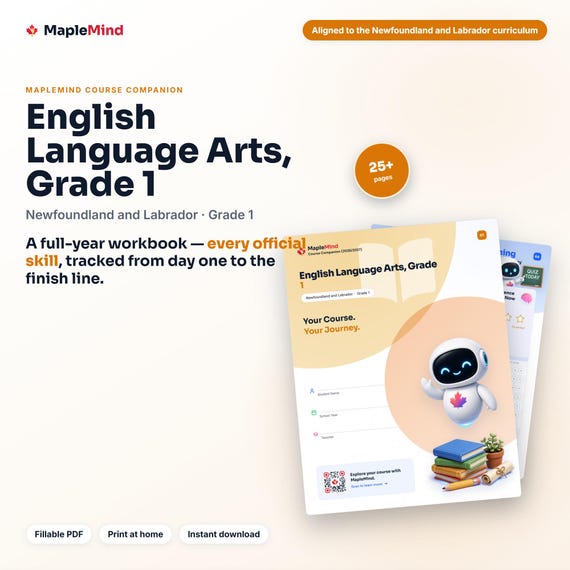
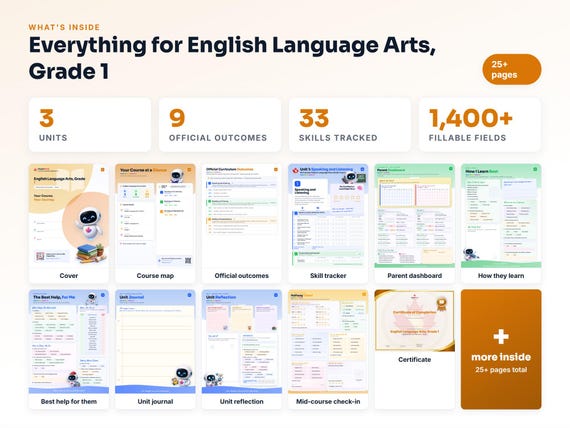
A English Language Arts, Grade 1 workbook worth keeping
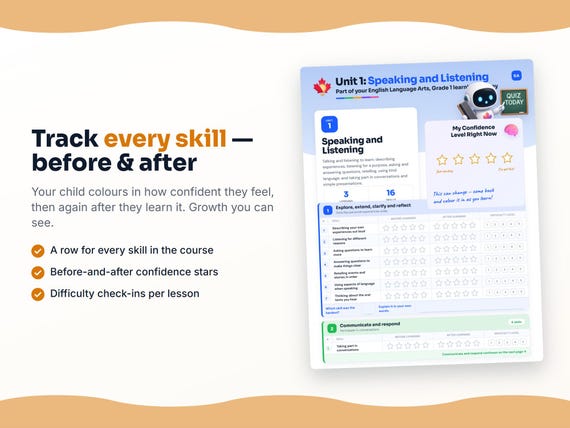
Built from the same official curriculum as this page. Before and after each skill above, your student colours in how sure they feel — so the two of you can see, on one page, what's clicking and what needs another look. It's a quiet way to follow how the year is really going.
By June it's full of their own handwriting: units worked through, confidence grown, a mid-year check-in, notes from parent-teacher night, and a certificate at the end. Less a worksheet, more a record of the year worth keeping on the shelf.
Instant download · see every page, reviews and the full description · five or more workbooks are $2.99 each
What it looks like in the app



Common questions
Can MapleMind help my child with English Language Arts, Grade 1?
Yes. MapleMind's AI tutor covers all 33 skills in Newfoundland and Labrador's English Language Arts, Grade 1 — your child picks the exact skill, and the tutor teaches it step by step: a short lesson, a worked example, solving together, then a skill check to show it stuck.
Is MapleMind aligned to Newfoundland and Labrador's official curriculum?
Yes. Every skill in this course maps to an official outcome code from Newfoundland and Labrador's Grade 1 English Language Arts curriculum, and the ministry's own wording is quoted under each unit on this page — with the official government source linked so you can check it yourself.
What does MapleMind cost?
It's free to start — 5 tutoring chats and a practice quiz every day, no credit card. A Pro subscription ($9.99/month or $49.99/year CAD, 7-day free trial) unlocks unlimited tutoring, practice, and exam simulations.
What if my child is stuck on just one topic?
That's the point of skill-level tutoring: open English Language Arts, Grade 1 in the app, tap the exact skill from the list on this page, and the tutor teaches just that — no wading through lessons your child doesn't need.
Does MapleMind work in French or other languages?
Yes — 14 languages, including French. Both the app and the tutor's explanations switch to the language your child chooses.
Where can I see the official Newfoundland and Labrador curriculum for English Language Arts, Grade 1?
The official source is linked on this page — Newfoundland and Labrador's official curriculum. The outline here follows it: every MapleMind skill carries its official outcome code, and the ministry's own wording is quoted under each unit.
Keep exploring
Ready when you are
Pick a skill from this page and see it taught properly — free, in the browser, in under a minute.