Get help with English Language Arts, Grade 1
Most tutoring makes your child sit through material your child already knows. MapleMind flips that: pick the exact skill that's causing trouble — any of the 22 below — and the tutor teaches just that one, step by step, as many times as it takes. Ask questions in plain words, any time of day, in English, French, or 12 other languages.
The official New Brunswick English Language Arts, Grade 1 curriculum
New Brunswick defines English Language Arts, Grade 1 by strands and outcomes. MapleMind teaches the same curriculum reorganized for one-skill-at-a-time tutoring — the table shows exactly where every official strand lands, and the ministry's own wording is quoted under each unit below.
Official source New Brunswick's official K-12 education resourcesRead it on the government site — www2.gnb.ca ↗| Official strand | Outcomes | Where MapleMind teaches it |
|---|---|---|
| Strand I | 9 | Interactions |
| Strand R | 8 | Reading |
| Strand P | 5 | Representations |
Every skill below, taught one on one.
 Try the first session free
How MapleMind teaches English Language Arts, Grade 1 — every unit, lesson, and skill
Every skill below runs as a short session: a plain-words lesson, a worked example, solving it together, then a five-question skill check that earns up to three stars. Guided Mode keeps it teaching instead of answer-handing — turning it off needs a parent's password.
Unit 1InteractionsOfficial strand · Strand I
Oral and social communication: sharing feelings, ideas, and opinions; asking and answering questions; giving and following directions; and using kind, respectful language and communication habits.
Sharing feelings, ideas, and listening well
- Sharing feelings and opinionsNB-ELA-1.1.1 — Express feelings and opinions and give simple descriptions of experiences out loud.
- Telling facts, ideas, and opinions to othersNB-ELA-1.1.2 — Present simple facts, ideas, and opinions to peers and teachers.
- Beginning to ask and answer questionsNB-ELA-1.1.4 — Begin to ask and respond to questions during talk and stories.
- Giving and following simple directionsNB-ELA-1.1.5 — Give and follow simple one- or two-step directions or instructions.
- Responding to stories and presentationsNB-ELA-1.1.7 — Respond personally to presentations, oral stories, and multimodal text.
- Welcoming the ideas of othersNB-ELA-1.1.9 — Receive the ideas and opinions of others with attention and respect.
Kind language and community habits
- Exploring words of harmony and respectNB-ELA-1.1.3 — Explore the language of harmony and respect in the classroom.
- Exploring how we talk togetherNB-ELA-1.1.6 — Explore appropriate communication conventions such as turn-taking and looking at the speaker.
The official wording — 9 outcomes in this unit
- NB-ELA-1.1.1
Express feelings and opinions, and give simple descriptions of experiences.
- NB-ELA-1.1.2
Present simple facts, ideas, and opinions to peers and teachers.
- NB-ELA-1.1.4
Begin to ask and respond to questions.
- NB-ELA-1.1.5
Give and follow simple, one or two step directions or instructions.
- NB-ELA-1.1.7
Respond personally to presentations, oral stories, and multi- modal text.
- NB-ELA-1.1.9
Receive the ideas and opinions of others.
- NB-ELA-1.1.3
Explore the language of harmony and respect.
- NB-ELA-1.1.6
Explore appropriate communication conventions.
- NB-ELA-1.1.8
Explore social conventions when interacting.
Unit 2ReadingOfficial strand · Strand R
Decoding and comprehension: concepts of print, phonological awareness, letter-sound decoding, fluent reading of familiar words, vocabulary, constructing meaning, and beginning text awareness.
Print, sounds, and cracking the code
- Identifying concepts of printNB-ELA-1.2.1 — Identify concepts of print such as reading left to right, top to bottom, and knowing where a word begins and ends.
- Hearing the sounds in spoken wordsNB-ELA-1.2.2 — Demonstrate an awareness of sounds in spoken language: rhyme, syllables, and beginning sounds.
- Using letters and sounds to decode wordsNB-ELA-1.2.3 — Apply letter-sound knowledge to decode words and connected text.
Reading smoothly and making meaning
- Reading familiar words with accuracy and expressionNB-ELA-1.2.4 — Read familiar words in developmentally appropriate text passages with accuracy and expression.
- Using a range of words to communicateNB-ELA-1.2.5 — Use a range of vocabulary when communicating ideas.
- Constructing meaning from stories and textNB-ELA-1.2.6 — Construct meaning from oral stories, read-alouds, and text.
Choosing books and knowing text kinds
- Choosing texts for a purposeNB-ELA-1.2.7 — Select and engage with a variety of text forms for specific uses.
- Beginning to identify kinds of textNB-ELA-1.2.8 — Begin to identify characteristics, forms, features, and types of text.
The official wording — 8 outcomes in this unit
- NB-ELA-1.2.1
Identify concepts of print.
- NB-ELA-1.2.2
Demonstrate an awareness of sounds in spoken language.
- NB-ELA-1.2.3
Apply letter-sound knowledge to decode words and connected text.
- NB-ELA-1.2.4
Read familiar words in developmentally appropriate text passages with accuracy and expression.
- NB-ELA-1.2.5
Use a range of vocabulary when communicating.
- NB-ELA-1.2.6
Construct meaning from oral stories, read-alouds, and text.
- NB-ELA-1.2.7
Select and engage with a variety of text forms for specific uses.
- NB-ELA-1.2.8
Begin to identify characteristics, forms, features, and types of text.
Unit 3RepresentationsOfficial strand · Strand P
Writing, encoding, and media creation: printing letters and sentences, basic spelling, composing complete sentences, organizing ideas into texts, and beginning to seek information.
Printing letters and spelling words
- Printing letters, words, and sentencesNB-ELA-1.3.1 — Print or represent letters, words, and sentences using a writing utensil or assistive technology.
- Using basic spelling to write wordsNB-ELA-1.3.2 — Apply basic spelling conventions when creating written works.
Composing sentences and creating texts
- Composing complete thoughts and sentencesNB-ELA-1.3.3 — Compose complete thoughts and sentences.
- Organizing ideas and creating textsNB-ELA-1.3.4 — Organize ideas and create written or media texts.
- Beginning to seek information for ideasNB-ELA-1.3.5 — Begin to seek information to support ideas and construct meaning.
The official wording — 5 outcomes in this unit
- NB-ELA-1.3.1
Print or represent letters, words, and sentences using a writing utensil or assistive technology.
- NB-ELA-1.3.2
Apply basic spelling conventions when creating written works.
- NB-ELA-1.3.3
Compose complete thoughts and sentences.
- NB-ELA-1.3.4
Organize ideas and create written or media texts.
- NB-ELA-1.3.5
Begin to seek information to support ideas and construct meaning.
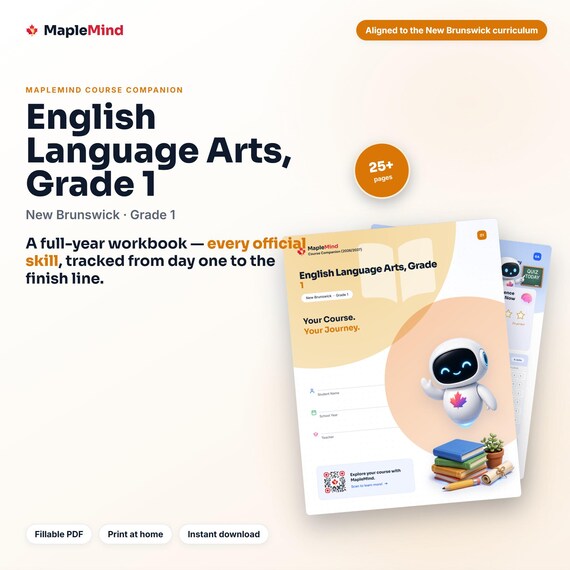
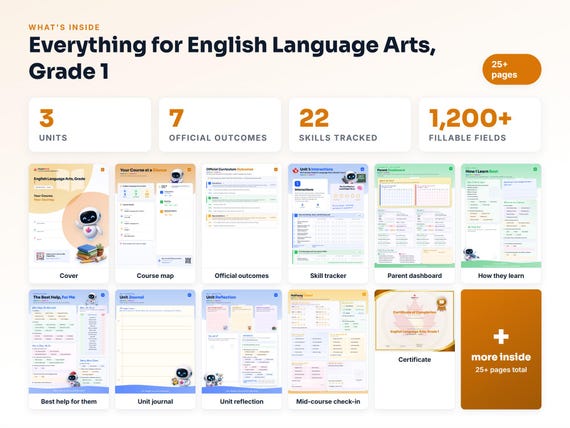
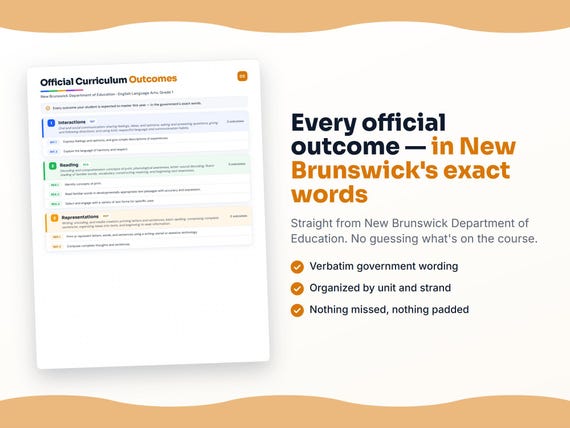
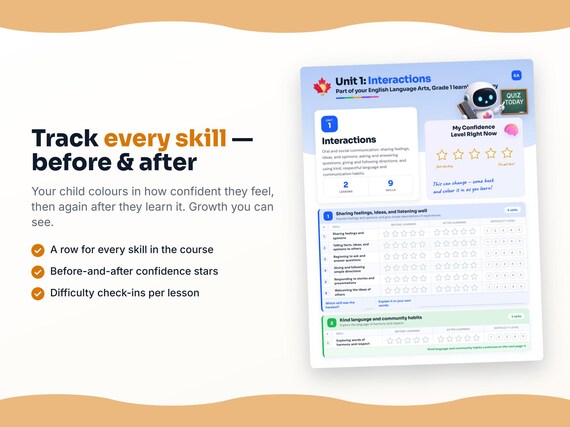
Printable workbook · A keepsake of the year
A English Language Arts, Grade 1 workbook worth keeping
Built from the same official curriculum as this page. Before and after each skill above, your student colours in how sure they feel — so the two of you can see, on one page, what's clicking and what needs another look. It's a quiet way to follow how the year is really going.
By June it's full of their own handwriting: units worked through, confidence grown, a mid-year check-in, notes from parent-teacher night, and a certificate at the end. Less a worksheet, more a record of the year worth keeping on the shelf.
Instant download · see every page, reviews and the full description · five or more workbooks are $2.99 each
What it looks like in the app



Common questions
Can MapleMind help my child with English Language Arts, Grade 1?
Yes. MapleMind's AI tutor covers all 22 skills in New Brunswick's English Language Arts, Grade 1 — your child picks the exact skill, and the tutor teaches it step by step: a short lesson, a worked example, solving together, then a skill check to show it stuck.
Is MapleMind aligned to New Brunswick's official curriculum?
Yes. Every skill in this course maps to an official outcome code from New Brunswick's Grade 1 English Language Arts curriculum, and the ministry's own wording is quoted under each unit on this page — with the official government source linked so you can check it yourself.
What does MapleMind cost?
It's free to start — 5 tutoring chats and a practice quiz every day, no credit card. A Pro subscription ($9.99/month or $49.99/year CAD, 7-day free trial) unlocks unlimited tutoring, practice, and exam simulations.
What if my child is stuck on just one topic?
That's the point of skill-level tutoring: open English Language Arts, Grade 1 in the app, tap the exact skill from the list on this page, and the tutor teaches just that — no wading through lessons your child doesn't need.
Does MapleMind work in French or other languages?
Yes — 14 languages, including French. Both the app and the tutor's explanations switch to the language your child chooses.
Where can I see the official New Brunswick curriculum for English Language Arts, Grade 1?
The official source is linked on this page — New Brunswick's official K-12 education resources. The outline here follows it: every MapleMind skill carries its official outcome code, and the ministry's own wording is quoted under each unit.
Keep exploring
Ready when you are
Pick a skill from this page and see it taught properly — free, in the browser, in under a minute.