Get help with English Language Arts, Grade 3
Most tutoring makes your child sit through material your child already knows. MapleMind flips that: pick the exact skill that's causing trouble — any of the 50 below — and the tutor teaches just that one, step by step, as many times as it takes. Ask questions in plain words, any time of day, in English, French, or 12 other languages.
The official Manitoba English Language Arts, Grade 3 curriculum
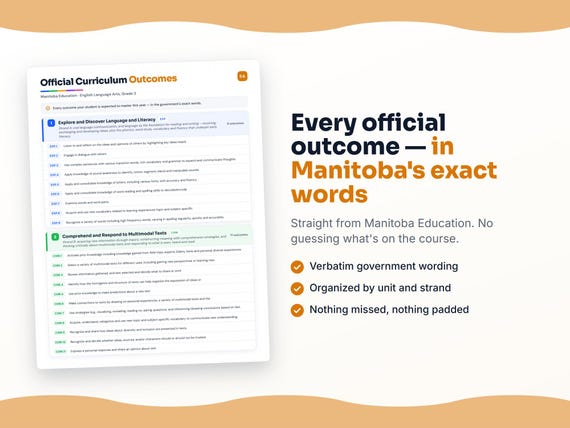
Manitoba defines English Language Arts, Grade 3 by strands and outcomes. MapleMind teaches the same curriculum reorganized for one-skill-at-a-time tutoring — the table shows exactly where every official strand lands, and the ministry's own wording is quoted under each unit below.
Official source Manitoba's official curriculumRead it on the government site — edu.gov.mb.ca ↗| Official strand | Outcomes | Where MapleMind teaches it |
|---|---|---|
| Strand A | 12 | Explore and Discover Language and Literacy |
| Strand B | 15 | Comprehend and Respond to Multimodal Texts |
| Strand C | 15 | Compose and Create Multimodal Texts |
| Strand D | 8 | Communicate Ideas and Build New Understandings |
Every skill below, taught one on one.
 Try the first session free
How MapleMind teaches English Language Arts, Grade 3 — every unit, lesson, and skill
Every skill below runs as a short session: a plain-words lesson, a worked example, solving it together, then a five-question skill check that earns up to three stars. Guided Mode keeps it teaching instead of answer-handing — turning it off needs a parent's password.
Unit 1Explore and Discover Language and LiteracyOfficial strand · Strand A
Strand A: oral language communication, and language as the foundation for reading and writing - receiving, exchanging and developing ideas, plus the phonics, word study, vocabulary and fluency that underpin early literacy.
Listening (Receptive)
- Listen to and reflect on the ideasELA.3.A1.1 — Listen to and reflect on the ideas and opinions of others by highlighting key ideas heard.
Interacting
- Engage in dialogue with others (partners, small/largeELA.3.A1.3 — Engage in dialogue with others (partners, small/large group) to express and understand ideas.
- Ask thoughtful questions to begin to thinkELA.3.A1.4 — Ask thoughtful questions to begin to think critically about content and respond to questions by providing evidence to support thinking.
Speaking (Expressive)
- Use complex sentences with various transition wordsELA.3.A1.5 — Use complex sentences with various transition words, rich vocabulary and grammar to expand and communicate thoughts and ideas.
- Contribute their voice to discuss thoughts, feelingsELA.3.A1.6 — Contribute their voice to discuss thoughts, feelings, ideas, opinions and express preferences.
Phonological and Phonemic Awareness
- Apply knowledge of sound awareness to identifyELA.3.A2.1 — Apply knowledge of sound awareness to identify, notice, segment, blend and manipulate sounds (phonemes) in words; use alphabet knowledge flexibly/fluently in the context of decoding and spelling written words.
Alphabetic Knowledge
- Apply and consolidate knowledge of letters, includingELA.3.A2.2 — Apply and consolidate knowledge of letters, including various fonts, with accuracy and fluency.
Phonics, Decoding and Spelling
- Apply and consolidate knowledge of word readingELA.3.A2.3 — Apply and consolidate knowledge of word reading and spelling skills to decode/encode (spell) more complex multisyllabic words in isolation and in various texts with increasing accuracy and automaticity.
Word Study (Morphology)
- Examine words and word parts (morphemes) inELA.3.A2.4 — Examine words and word parts (morphemes) in reading and writing to determine word meaning and increase accurate spelling.
Vocabulary
Reading Fluency
- Recognize a variety of words including highELA.3.A2.6 — Recognize a variety of words including high frequency words, varying in spelling regularity, quickly and accurately; notice and use punctuation in a variety of text forms to read with appropriate rate, pace, intonation, phrasing, pausing and word stress (prosody).
The official wording — 12 outcomes in this unit
- ELA.3.A1.1
Listen to and reflect on the ideas and opinions of others by highlighting key ideas heard.
- ELA.3.A1.2
Use non-verbal cues and social conventions
- ELA.3.A1.3
Engage in dialogue with others
- ELA.3.A1.4
Ask thoughtful questions to begin to think critically about content and respond to questions by providing
- ELA.3.A1.5
Use complex sentences with various transition words, rich vocabulary and grammar to expand and communicate thoughts
- ELA.3.A1.6
Contribute their voice to discuss thoughts, feelings, ideas, opinions and express preferences.
- ELA.3.A2.1
Apply knowledge of sound awareness to identify, notice, segment, blend and manipulate sounds
- ELA.3.A2.2
Apply and consolidate knowledge of letters, including various fonts, with accuracy and fluency.
- ELA.3.A2.3
Apply and consolidate knowledge of word reading and spelling skills to decode/encode
- ELA.3.A2.4
Examine words and word parts
- ELA.3.A2.5
Acquire and use new vocabulary related to learning experiences topic and subject specific
- ELA.3.A2.6
Recognize a variety of words including high frequency words, varying in spelling regularity, quickly and accurately
Unit 2Comprehend and Respond to Multimodal TextsOfficial strand · Strand B
Strand B: acquiring new information through inquiry, constructing meaning with comprehension strategies, and thinking critically about multimodal texts and responding to what is seen, heard and read.
Activate Prior Knowledge and Inquire
- Activate prior knowledge including knowledge gained fromELA.3.B1.1 — Activate prior knowledge including knowledge gained from field trips, experts, Elders, texts and personal diverse experiences to understand new topics and forms of text.
- Develop focused questions based on observations to drive group investigationsELA.3.B1.2 — Develop focused questions based on observations to drive group investigations
Engage with a Variety of Texts
- Select a variety of multimodal texts forELA.3.B1.3 — Select a variety of multimodal texts for different uses, including gaining new perspectives or learning new information to build background knowledge.
Review Information
- Review information gathered, and text selected and decide what to share or omitELA.3.B1.4 — Review information gathered, and text selected and decide what to share or omit (e.g., facts, ideas).
Identify Text Cues
- Identify how the form/genre and structure ofELA.3.B2.1 — Identify how the form/genre and structure of texts can help organize the expression of ideas or information to help with understanding (e.g., poetry: haiku (3 lines - 5, 7, 5 syllables)).
- Use images, photographs, and other text featuresELA.3.B2.2 — Use images, photographs, and other text features (e.g., charts, diagrams, labels) from multimodal forms of fiction and nonfiction to construct meaning.
Make Predictions
- Use prior knowledge to make predictions aboutELA.3.B2.3 — Use prior knowledge to make predictions about a new text; continue to make predictions about what might happen next and confirm predictions while engaging in text.
Make Connections
- Make connections to texts by drawing onELA.3.B2.4 — Make connections to texts by drawing on personal experiences, a variety of multimodal texts and the world to construct meaning.
Monitor Understanding
- Use strategies to confirm understandingELA.3.B2.5 — Use strategies (e.g., visualizing, rereading, reading on, asking questions, and inferencing (drawing conclusions based on text evidence /sources) to confirm understanding.
Consolidate New Knowledge
- Acquire, understand, categorize and use new topicELA.3.B2.7 — Acquire, understand, categorize and use new topic and subject specific vocabulary to communicate new understanding.
Analyze Text
Recognize Facts, Bias and Viewpoints
- Recognize and decide whether ideas, sources, and/orELA.3.B3.2 — Recognize and decide whether ideas, sources, and/or characters should or should not be trusted; begin to identify examples of stereotyping, bias or prejudice with guidance.
- Recognize content presented in both fiction and nonfiction can highlight different viewpointsELA.3.B3.3 — Recognize content presented in both fiction and nonfiction can highlight different viewpoints.
Respond to Text
The official wording — 15 outcomes in this unit
- ELA.3.B1.1
Activate prior knowledge including knowledge gained from field trips, experts, Elders, texts and personal diverse experiences
- ELA.3.B1.2
Develop focused questions based on observations to drive group investigations
- ELA.3.B1.3
Select a variety of multimodal texts for different uses, including gaining new perspectives or learning new
- ELA.3.B1.4
Review information gathered, and text selected and decide what to share or omit
- ELA.3.B2.1
Identify how the form/genre and structure of texts can help organize the expression of ideas or
- ELA.3.B2.2
Use images, photographs, and other text features
- ELA.3.B2.3
Use prior knowledge to make predictions about a new text
- ELA.3.B2.4
Make connections to texts by drawing on personal experiences, a variety of multimodal texts and the
- ELA.3.B2.5
Use strategies (e.g., visualizing, rereading, reading on, asking questions, and inferencing (drawing conclusions based on text
- ELA.3.B2.6
Recall and share important information from texts in logical order using own words.
- ELA.3.B2.7
Acquire, understand, categorize and use new topic and subject specific vocabulary to communicate new understanding.
- ELA.3.B3.1
Recognize and share how ideas about diversity and inclusion are presented in texts.
- ELA.3.B3.2
Recognize and decide whether ideas, sources, and/or characters should or should not be trusted
- ELA.3.B3.3
Recognize content presented in both fiction and nonfiction can highlight different viewpoints.
- ELA.3.B3.4
Express a personal response and share an opinion about text
Unit 3Compose and Create Multimodal TextsOfficial strand · Strand C
Strand C: generating ideas and planning, enhancing the clarity and artistry of writing, and editing and publishing multimodal texts for a range of purposes and audiences.
Generate Ideas
- Generate and select a topic with ideasELA.3.C1.1 — Generate and select a topic with ideas integrated from personal experience, background knowledge and prior learning appropriate for a particular audience and purpose.
Research Sources
- Discuss new information gathered from a varietyELA.3.C1.2 — Discuss new information gathered from a variety of relevant sources, including modelled text, various text styles and mentors (e.g., experts, audio, digital online sources).
Plan for Text Creation
- Use strategies to plan for text creationELA.3.C1.3 — Use strategies (e.g., brainstorming, listing, asking questions, word webbing, drawings, thinking maps, research planners) to plan for text creation.
Choose Form
- Experiment with different types of writing (narrativeELA.3.C1.4 — Experiment with different types of writing (narrative, informational, descriptive and persuasive) and genres to inform text creation for different purposes and audiences.
Create Draft/Prototype
- Create multimodal texts; use digital toolsELA.3.C1.5 — Create multimodal texts (e.g., oral storytelling, written stories, posters, songs, research reports/projects, photo essays, interactive notebooks, slide show with narration); use digital tools and organizers with increasing independence; plan layouts; select relevant visuals and use appropriate elements (e.g., font, colour, imagery) to draft ideas effectively and creatively.
Organize Ideas
- Experiment with organizational patternsELA.3.C2.1 — Experiment with organizational patterns (e.g., description, compare and contrast, problem-solution); introduce topic and provide a sense of closure to match the text form chosen.
Sentence Structure
- Produce, expand and rearrange complete simple and compound sentences; use connecting wordsELA.3.C2.2 — Produce, expand and rearrange complete simple and compound sentences; use connecting words (e.g., and, but, so); vary the way sentences start.
Word Choice
- Use more specific word choice (more preciseELA.3.C2.3 — Use more specific word choice (more precise nouns, adjectives, and verbs) in text creation to enhance meaning for the audience.
Voice and Style
- Demonstrate personal voice in texts, using descriptiveELA.3.C2.4 — Demonstrate personal voice in texts, using descriptive words, varied sentence patterns and images/illustrations to communicate thoughts, feelings and opinions about a topic with others.
Revision
- Notice when writing does not make senseELA.3.C2.5 — Notice when writing does not make sense and make simple revisions; seek feedback to reorganize ideas, add, or remove text, and change words to improve content and clarity.
Legibility and Word Processing
- Form letters/words with accurate formation, size, placementELA.3.C3.1 — Form letters/words with accurate formation, size, placement and spacing using margins to ensure legibility; use fluent word processing skills, choose font style, font size and color to enhance text for an audience.
Spelling
- Demonstrate knowledge of word meanings, spelling patternsELA.3.C3.2 — Demonstrate knowledge of word meanings, spelling patterns (vowel combinations), word parts (morphemes, prefixes, suffixes) and digital spell check to spell multisyllabic words.
Capitalization
- Use capital letters consistently and accurately for proper nouns, titles, and dialogueELA.3.C3.3 — Use capital letters consistently and accurately for proper nouns, titles, and dialogue.
Punctuation
- Know and use punctuation conventions to communicateELA.3.C3.4 — Know and use punctuation conventions (e.g., periods, exclamation marks, question marks, apostrophes, quotation marks) to communicate meaning clearly for others.
Publish Final Text
- Develop final text and understand the purposeELA.3.C3.5 — Develop final text and understand the purpose and effect of different modes of communication; integrate more than one mode (e.g., text, images, sound, video) to communicate message for a specific purpose and audience.
The official wording — 15 outcomes in this unit
- ELA.3.C1.1
Generate and select a topic with ideas integrated from personal experience, background knowledge and prior learning
- ELA.3.C1.2
Discuss new information gathered from a variety of relevant sources, including modelled text, various text styles
- ELA.3.C1.3
Use strategies (e.g., brainstorming, listing, asking questions, word webbing, drawings, thinking maps, research planners) to plan
- ELA.3.C1.4
Experiment with different types of writing
- ELA.3.C1.5
Create multimodal texts
- ELA.3.C2.1
Experiment with organizational patterns
- ELA.3.C2.2
Produce, expand and rearrange complete simple and compound sentences
- ELA.3.C2.3
Use more specific word choice
- ELA.3.C2.4
Demonstrate personal voice in texts, using descriptive words, varied sentence patterns and images/illustrations to communicate thoughts
- ELA.3.C2.5
Notice when writing does not make sense and make simple revisions
- ELA.3.C3.1
Form letters/words with accurate formation, size, placement and spacing using margins to ensure legibility
- ELA.3.C3.2
Demonstrate knowledge of word meanings, spelling patterns
- ELA.3.C3.3
Use capital letters consistently and accurately for proper nouns, titles, and dialogue.
- ELA.3.C3.4
Know and use punctuation conventions
- ELA.3.C3.5
Develop final text and understand the purpose and effect of different modes of communication
Unit 4Communicate Ideas and Build New UnderstandingsOfficial strand · Strand D
Strand D: sharing ideas and information for different audiences, and using metacognition to self-assess, set goals and monitor progress as an independent learner.
Express Ideas and Engage Audience
- Adjust intonation, tone, volume, expression and communicationELA.3.D1.1 — Adjust intonation, tone, volume, expression and communication style to share ideas.
- Choose artifacts to enhance message; use visualELA.3.D1.2 — Choose artifacts to enhance message; use visual aids/digital tools to share ideas.
- Present ideas and information with supporting detailsELA.3.D1.3 — Present ideas and information with supporting details in an organized, logical sequence to an audience.
Self-Assess
- Develop self-monitoring skills; begin to think aloudELA.3.D2.1 — Develop self-monitoring skills; begin to think aloud wondering, “What strategies are working?” to reflect on the strategies to strengthen.
- Develop criteria with teacher support for assessingELA.3.D2.2 — Develop criteria with teacher support for assessing learning; use tools such as journals, mind maps, lists, rubrics, digital tools (e.g. podcasts) to self-assess own understanding/learning.
- Receive descriptive feedback from others to understandELA.3.D2.3 — Receive descriptive feedback from others to understand what they did well and what they need to work on and decide on changes; reflect on learning processes/strategies (e.g., using criteria) and think about next steps.
Set Goals and Monitor Progress
- Monitor and track progress; reflect on accomplishmentsELA.3.D2.5 — Monitor and track progress; reflect on accomplishments of new learning.
The official wording — 8 outcomes in this unit
- ELA.3.D1.1
Adjust intonation, tone, volume, expression and communication style to share ideas.
- ELA.3.D1.2
Choose artifacts to enhance message
- ELA.3.D1.3
Present ideas and information with supporting details in an organized, logical sequence to an audience.
- ELA.3.D2.1
Develop self-monitoring skills
- ELA.3.D2.2
Develop criteria with teacher support for assessing learning
- ELA.3.D2.3
Receive descriptive feedback from others to understand what they did well and what they need to
- ELA.3.D2.4
Set specific learning goals related to listening, speaking, reading, writing, viewing or representing.
- ELA.3.D2.5
Monitor and track progress
Printable workbook · A keepsake of the year
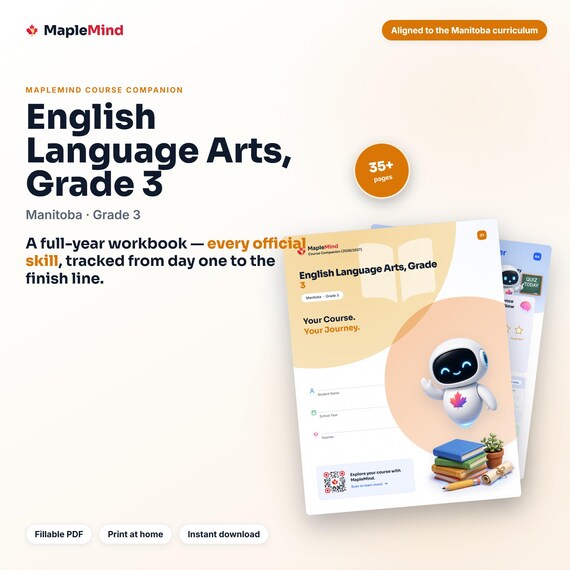
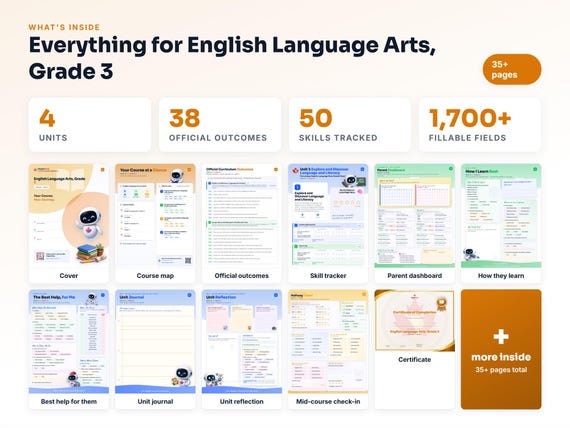
A English Language Arts, Grade 3 workbook worth keeping
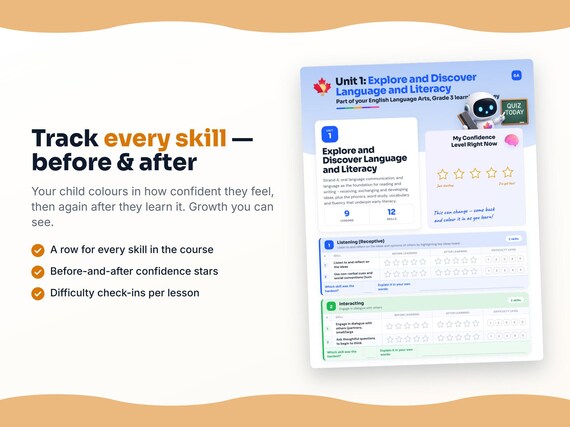
Built from the same official curriculum as this page. Before and after each skill above, your student colours in how sure they feel — so the two of you can see, on one page, what's clicking and what needs another look. It's a quiet way to follow how the year is really going.
By June it's full of their own handwriting: units worked through, confidence grown, a mid-year check-in, notes from parent-teacher night, and a certificate at the end. Less a worksheet, more a record of the year worth keeping on the shelf.
Instant download · see every page, reviews and the full description · five or more workbooks are $2.99 each
What it looks like in the app



Common questions
Can MapleMind help my child with English Language Arts, Grade 3?
Yes. MapleMind's AI tutor covers all 50 skills in Manitoba's English Language Arts, Grade 3 — your child picks the exact skill, and the tutor teaches it step by step: a short lesson, a worked example, solving together, then a skill check to show it stuck.
Is MapleMind aligned to Manitoba's official curriculum?
Yes. Every skill in this course maps to an official outcome code from Manitoba's Grade 3 English Language Arts curriculum, and the ministry's own wording is quoted under each unit on this page — with the official government source linked so you can check it yourself.
What does MapleMind cost?
It's free to start — 5 tutoring chats and a practice quiz every day, no credit card. A Pro subscription ($9.99/month or $49.99/year CAD, 7-day free trial) unlocks unlimited tutoring, practice, and exam simulations.
What if my child is stuck on just one topic?
That's the point of skill-level tutoring: open English Language Arts, Grade 3 in the app, tap the exact skill from the list on this page, and the tutor teaches just that — no wading through lessons your child doesn't need.
Does MapleMind work in French or other languages?
Yes — 14 languages, including French. Both the app and the tutor's explanations switch to the language your child chooses.
Where can I see the official Manitoba curriculum for English Language Arts, Grade 3?
The official source is linked on this page — Manitoba's official curriculum. The outline here follows it: every MapleMind skill carries its official outcome code, and the ministry's own wording is quoted under each unit.
Keep exploring
Ready when you are
Pick a skill from this page and see it taught properly — free, in the browser, in under a minute.