Get help with Core French 12
Most tutoring makes you sit through material you already know. MapleMind flips that: pick the exact skill that's causing trouble — any of the 27 below — and the tutor teaches just that one, step by step, as many times as it takes. Ask questions in plain words, any time of day, in English, French, or 12 other languages.
The official British Columbia Core French 12 curriculum
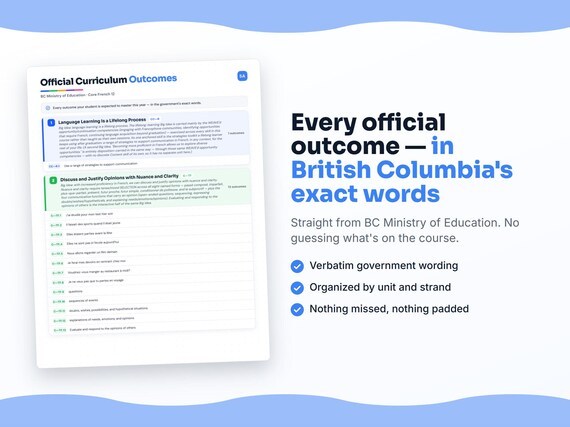
British Columbia defines Core French 12 by strands and outcomes. MapleMind teaches the same curriculum reorganized for one-skill-at-a-time tutoring — the table shows exactly where every official strand lands, and the ministry's own wording is quoted under each unit below.
Official source BC's official curriculumRead it on the government site — curriculum.gov.bc.ca ↗| Official strand | Outcomes | Where MapleMind teaches it |
|---|---|---|
| Curricular Competencies — Receptive competencies | 1 | Language Learning Is a Lifelong Process |
| Content — Time frames, moods, and communicative functions | 13 | Discuss and Justify Opinions with Nuance and Clarity |
| Curricular Competencies — Productive competencies | 3 | Sharing Feelings and Opinions Enhances French-Speaker Identity |
| Content — Ethics of expression, and Culture and connection | 3 | Appreciating Francophone Cultures to Explore Global Issues |
| Content — Register and etiquette, Idiomatic expressions; Curricular Competencies — Receptive competencies | 7 | Diverse Forms of Cultural Expression Worldwide |
Every skill below, taught one on one.
 Try the first session free
How MapleMind teaches Core French 12 — every unit, lesson, and skill
Every skill below runs as a short session: a plain-words lesson, a worked example, solving it together, then a five-question skill check that earns up to three stars. Guided Mode keeps it teaching instead of answer-handing — turning it off needs a parent's password.
Unit 1Language Learning Is a Lifelong ProcessOfficial strand · Curricular Competencies — Receptive competencies
Big Idea: language learning is a lifelong process. The lifelong-learning Big Idea is carried mainly by the WEAVE'd opportunity/continuation competencies (engaging with Francophone communities, identifying opportunities that require French, continuing language acquisition beyond graduation) — exercised across every skill in this course rather than taught as their own sessions. Its one anchored skill is the strategies toolkit a lifelong learner keeps using after graduation: a range of strategies to support communication in French, in any context, for the rest of your life. (A second Big Idea, "Becoming more proficient in French allows us to explore diverse opportunities," is entirely disposition-carried in the same way — through those same WEAVE'd opportunity competencies — with no discrete Content skill of its own, so it has no separate unit here.)
Communication Strategies
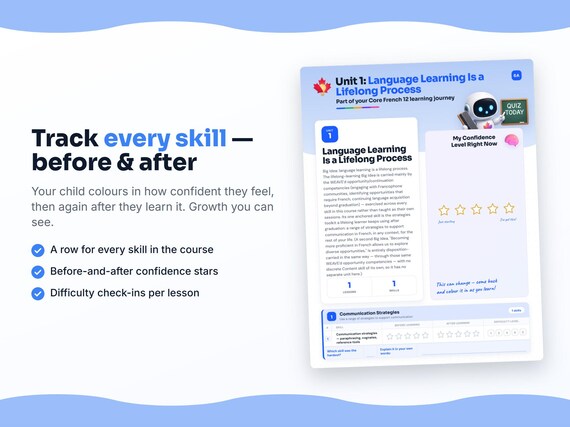
- Communication strategies — paraphrasing, cognates, reference tools12.STRAT.1 — Use a range of strategies to keep a conversation or a reading going when you hit a gap — paraphrasing what you mean a different way, leaning on cognates and context, and reaching for a reference tool — the toolkit a lifelong French learner keeps using long after graduation.
The official wording — 1 outcome in this unit
- 12.STRAT.1
Use a range of strategies to support communication
Unit 2Discuss and Justify Opinions with Nuance and ClarityOfficial strand · Content — Time frames, moods, and communicative functions
Big Idea: with increased proficiency in French, we can discuss and justify opinions with nuance and clarity. Nuance and clarity require tense/mood SELECTION across all eight named forms — passé composé, imparfait, plus-que-parfait, présent, futur proche, futur simple, conditionnel de politesse, and le subjonctif — plus the four communicative functions that carry an opinion (open-ended questions, sequencing, expressing doubts/wishes/hypotheticals, and explaining needs/emotions/opinions). Evaluating and responding to the opinions of others is the interactive half of the same Big Idea.
Passé Composé
- Passé composé — narrating completed past actions12.TENSE.1 — Use the passé composé to narrate a completed action in the past — a single event that started and finished, like studying for a test the night before.
Imparfait
- Imparfait — habitual and descriptive past12.TENSE.2 — Use the imparfait for habitual or ongoing/descriptive actions in the past — what someone used to do regularly or what was going on in the background, like playing sports as a kid.
Plus-que-parfait
- Plus-que-parfait — the past before the past12.TENSE.3 — Use the plus-que-parfait to mark an action that happened BEFORE another past action — the "past before the past" — like people having already left before a party started.
Présent
- Présent — selecting the present in a multi-tense text12.TENSE.4 — Select the présent correctly inside a text that mixes several time frames — recognizing when an action is happening right now, like someone not being at school today, rather than reaching for a past or future form out of habit.
Futur Proche
- Futur proche — near-future plans12.TENSE.5 — Use the futur proche (aller + infinitive) for planned, near-future actions — like watching a movie tomorrow — the go-to form for something you already intend to do soon.
Futur Simple
- Futur simple — the true future tense12.TENSE.6 — Use the futur simple as the true future tense for actions that are more distant or less immediately planned than a futur proche action — like doing homework once you get home.
Conditionnel de Politesse
- Conditionnel de politesse — polite and hypothetical requests12.TENSE.7 — Use the conditionnel de politesse to soften a request into something polite and hypothetical — like asking "would you like to eat at the restaurant at noon?" instead of a blunt command.
Le Subjonctif
- Le subjonctif — mood for doubt, wish, and necessity12.TENSE.8 — Use le subjonctif — a MOOD, not a tense — after expressions of doubt, wish, and necessity, like not wanting someone to leave on a trip, where the verb form itself signals that the action is not a stated fact.
Open-Ended Questions
- Open-ended questions to elicit a deeper response12.FUNC.1 — Ask open-ended questions built to draw out a deeper, more thoughtful response instead of a one-word answer — questions that invite a reason, a comparison, or an explanation.
Sequencing Extended Narration
- Sequencing extended narration with a rich connector set12.FUNC.2 — Sequence the events of an extended narration clearly, using a rich set of time connectors and transitional expressions so a listener or reader can follow a long story from start to finish.
Doubts, Wishes, Possibilities, and Hypotheticals
- Expressing doubts, wishes, possibilities, and hypotheticals (subjunctive triggers)12.FUNC.3 — Express doubts, wishes, possibilities, and hypothetical situations in French — the function that triggers le subjonctif and carries the nuance of what might be true, wished for, or possible rather than certain.
Explaining Needs, Emotions, and Opinions
- Explaining needs, emotions, and opinions with nuance12.FUNC.4 — Explain needs, emotions, and opinions with nuance in French — stating not just what you need, feel, or think, but why, with the precision a senior French speaker uses to be understood clearly.
Evaluating and Responding to Opinions
- Evaluating and responding to the opinions of others12.EVAL.1 — Evaluate an opinion someone else has shared and respond to it in French — agreeing, disagreeing, or complicating it with your own reasoning — the interactive, critical half of discussing opinions with nuance and clarity.
The official wording — 13 outcomes in this unit
- 12.TENSE.1
J’ai étudié pour mon test hier soir
- 12.TENSE.2
Il faisait des sports quand il était jeune
- 12.TENSE.3
Elles étaient parties avant la fête
- 12.TENSE.4
Elles ne sont pas à l’école aujourd’hui
- 12.TENSE.5
Nous allons regarder un film demain
- 12.TENSE.6
Je ferai mes devoirs en rentrant chez moi
- 12.TENSE.7
Voudriez-vous manger au restaurant à midi?
- 12.TENSE.8
Je ne veux pas que tu partes en voyage
- 12.FUNC.1
questions
- 12.FUNC.2
sequences of events
- 12.FUNC.3
doubts, wishes, possibilities, and hypothetical situations
- 12.FUNC.4
explanations of needs, emotions, and opinions
- 12.EVAL.1
Evaluate and respond to the opinions of others
Unit 3Sharing Feelings and Opinions Enhances French-Speaker IdentityOfficial strand · Curricular Competencies — Productive competencies
Big Idea: sharing our feelings, opinions, and beliefs in French enhances our identity as French speakers. The productive competencies through which a student expresses that identity: sustaining a meaningful conversation, choosing precise words and register, and narrating a story across time frames.
Sustaining Meaningful Conversations
- Sustaining meaningful conversations, orally and in writing12.CONV.1 — Engage in a meaningful conversation on a topic you care about — both aloud and in writing — carrying it beyond a single exchange into a real back-and-forth.
Word Choice and Register Nuance
- Word choice and register nuance — verb forms, pronouns, near-synonyms12.WORD.1 — Make deliberate word choices and adjust register to express exactly what you mean — choosing between verb forms, pronouns, and near-synonyms that carry subtly different shades of meaning.
Narrating Stories Across Time Frames
- Narrating stories across a variety of time frames12.NARR.1 — Narrate a story, both orally and in writing, moving confidently across a variety of time frames — past, present, and future — to tell it in the right order and with the right level of detail.
The official wording — 3 outcomes in this unit
- 12.CONV.1
Engage in meaningful conversations on a variety of topics of interest, both orally and in writing
- 12.WORD.1
Make word choices and adjust register to express intended meaning
- 12.NARR.1
Narrate stories, both orally and in writing
Unit 4Appreciating Francophone Cultures to Explore Global IssuesOfficial strand · Content — Ethics of expression, and Culture and connection
Big Idea: appreciation of Francophone cultures allows us to understand and explore global issues with greater awareness. First Peoples and Francophone interactions in Canada (Michif, Chinook Jargon, Innu writers on colonization) and the ethics standard — cultural appropriation and plagiarism/attribution — are the culture-and-awareness content here, pitched at students doing senior source-based work.
First Peoples and Francophone Interactions
- First Peoples and Francophone interactions — Michif and Chinook Jargon12.FPFR.1 — Recognize that language and culture in Canada have been shaped by the interactions of First Peoples and Francophone communities — from the Michif language to Chinook Jargon to First Peoples writers who have used French to write about colonization.
Ethics of Cultural Appropriation
- Ethics of cultural appropriation — permission, context, and misrepresentation12.ETHIC.1 — Recognize cultural appropriation — using a cultural motif, theme, "voice," image, knowledge, story, song, or drama without permission, without appropriate context, or in a way that misrepresents the real experience of the people it is drawn from.
Plagiarism and Attribution
- Plagiarism and attribution in source-based French work12.ETHIC.2 — Apply the ethics of plagiarism and attribution to your own source-based French work — crediting where ideas, quotes, and cultural material come from instead of presenting them as your own.
The official wording — 3 outcomes in this unit
- 12.FPFR.1
Recognize that language and culture have been influenced by the interactions of First Peoples and Francophone communities in Canada
- 12.ETHIC.1
cultural appropriation: use of a cultural motif, theme, “voice,” image, knowledge, story, song, or drama, shared without permission or without
- 12.ETHIC.2
ethics of cultural appropriation and plagiarism
Unit 5Diverse Forms of Cultural Expression WorldwideOfficial strand · Content — Register and etiquette, Idiomatic expressions; Curricular Competencies — Receptive competencies
Big Idea: exploring diverse forms of cultural expression promotes a greater understanding and appreciation of cultures worldwide. Idiomatic expressions from across la francophonie, register and etiquette variety, and interpreting a wide variety of authentic texts are the forms-of-expression skills here; regional variation across the Francophone world runs through the idiom and interpretation skills throughout.
Register — Formal versus Informal
- Register — formal versus informal speech and writing12.REG.1 — Recognize and use the elements that separate formal from informal speech and writing in French — the vocabulary and phrasing shifts that mark a register change.
Etiquette and Forms of Address
- Etiquette — forms of address and politeness conventions12.REG.2 — Apply French etiquette conventions such as addressing someone you have not met as Monsieur or Madame plus their surname or title, showing the right level of formality from the very first word.
Jargon, Abbreviations, and Txt Spk
- Jargon, abbreviations, and txt spk12.REG.3 — Recognize and use topic-specific jargon, abbreviations, and txt spk in informal written French — the compressed, register-marked vocabulary of texting and casual online writing.
Idioms with Avoir, Faire, Être
- Idioms with avoir, faire, être12.IDIOM.1 — Use common French idiomatic expressions built on avoir, faire, and être — fixed phrases whose meaning cannot be worked out word-by-word from the individual verbs.
Slang (l'Argot) Across la Francophonie
- Slang (l'argot) across la francophonie12.IDIOM.2 — Recognize and use slang expressions from l'argot found across the Francophone world — informal, register-marked vocabulary distinct from standard or textbook French.
Figurative and Fixed Idiomatic Expressions
- Figurative and fixed idiomatic expressions12.IDIOM.3 — Recognize and use figurative and fixed idiomatic expressions whose meaning must be learned as a whole rather than built from their individual words.
Interpreting Authentic French Texts
- Interpreting a wide variety of authentic French texts12.INTERP.1 — Explore and interpret a wide variety of authentic French texts — oral, written, visual, and digital — drawing meaning from each one's form and content.
The official wording — 7 outcomes in this unit
- 12.REG.1
elements of formal versus informal speech and writing
- 12.REG.2
etiquette, such as addressing people they have not met as Monsieur or Madame + surname/title
- 12.REG.3
use of topic-specific jargon, abbreviations, and txt spk
- 12.IDIOM.1
expressions using avoir, faire, être
- 12.IDIOM.2
expressions from l’argot
- 12.IDIOM.3
other expressions (e.g., coûter les yeux de la tête, c’est dommage, un coup de foudre)
- 12.INTERP.1
Explore and interpret a wide variety of texts
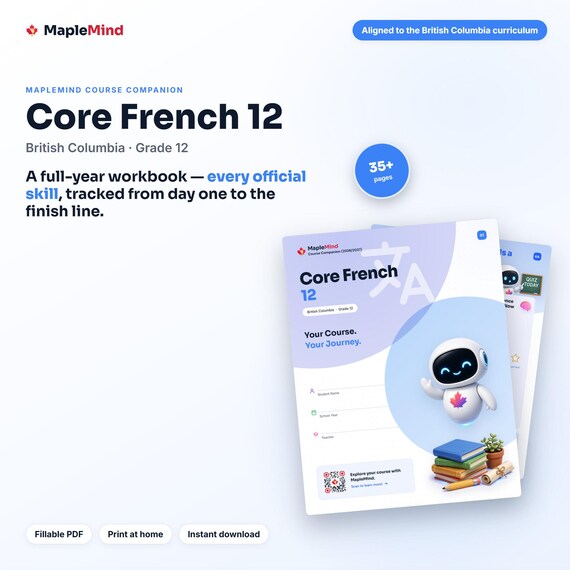
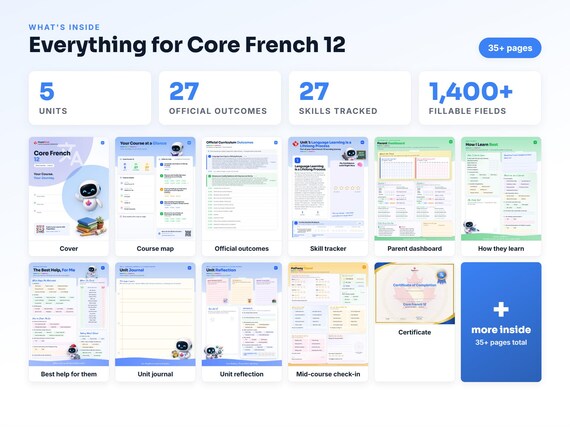
Printable workbook · A keepsake of the year
A Core French 12 workbook worth keeping
Built from the same official curriculum as this page. Before and after each skill above, your student colours in how sure they feel — so the two of you can see, on one page, what's clicking and what needs another look. It's a quiet way to follow how the year is really going.
By June it's full of their own handwriting: units worked through, confidence grown, a mid-year check-in, notes from parent-teacher night, and a certificate at the end. Less a worksheet, more a record of the year worth keeping on the shelf.
Instant download · see every page, reviews and the full description · five or more workbooks are $2.99 each
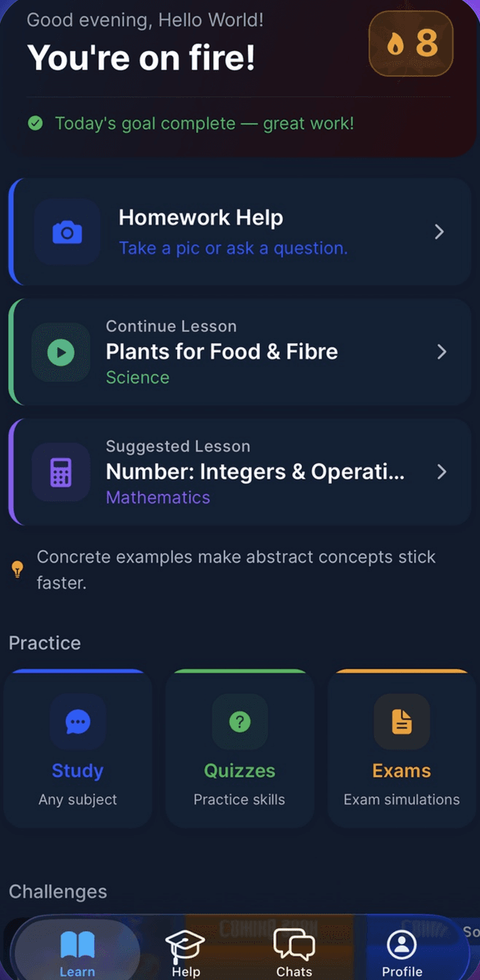
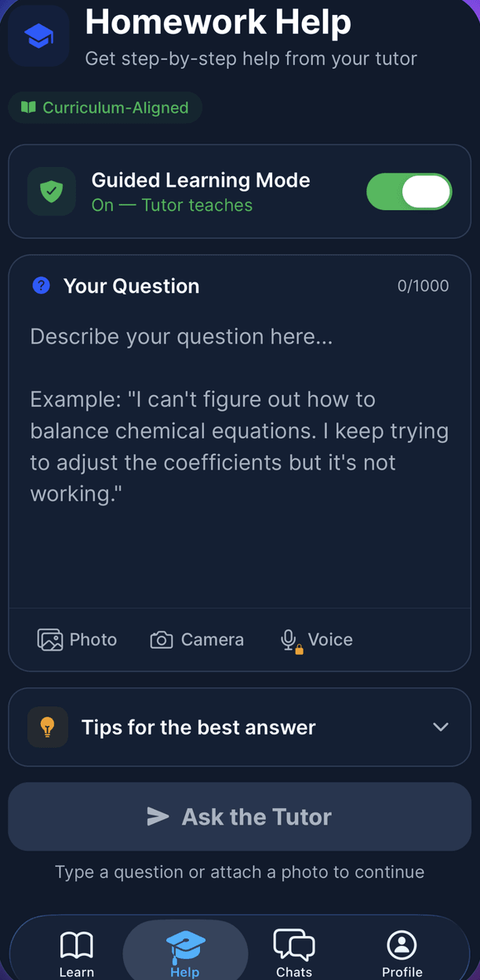
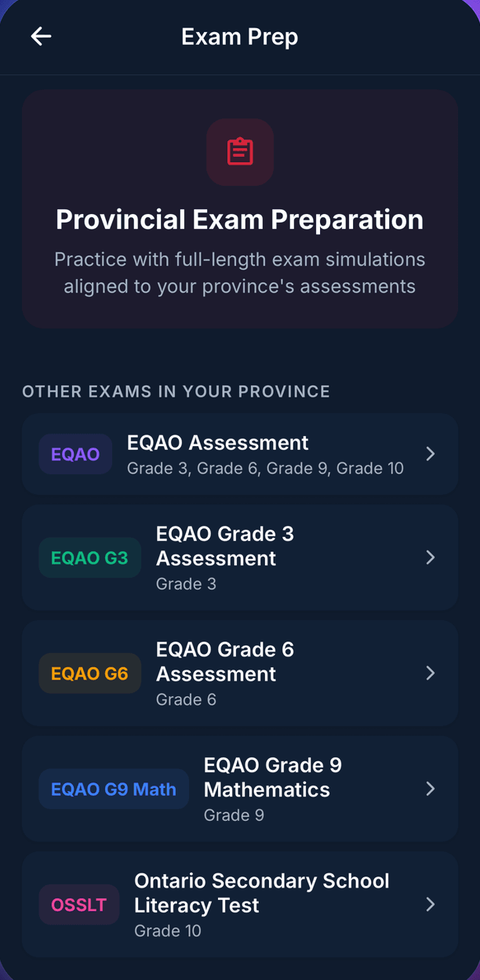
What it looks like in the app
Common questions
Can MapleMind help me with Core French 12?
Yes. MapleMind's AI tutor covers all 27 skills in British Columbia's Core French 12 — you pick the exact skill, and the tutor teaches it step by step: a short lesson, a worked example, solving together, then a skill check to show it stuck.
Is MapleMind aligned to British Columbia's official curriculum?
Yes. Every skill in this course maps to an official outcome code from British Columbia's Grade 12 French curriculum, and the ministry's own wording is quoted under each unit on this page — with the official government source linked so you can check it yourself.
What does MapleMind cost?
It's free to start — 5 tutoring chats and a practice quiz every day, no credit card. A Pro subscription ($9.99/month or $49.99/year CAD, 7-day free trial) unlocks unlimited tutoring, practice, and exam simulations.
What if I'm stuck on just one topic?
That's the point of skill-level tutoring: open Core French 12 in the app, tap the exact skill from the list on this page, and the tutor teaches just that — no wading through lessons you don't need.
Does MapleMind work in French or other languages?
Yes — 14 languages, including French. Both the app and the tutor's explanations switch to the language you choose.
Where can I see the official British Columbia curriculum for Core French 12?
The official source is linked on this page — BC's official curriculum. The outline here follows it: every MapleMind skill carries its official outcome code, and the ministry's own wording is quoted under each unit.
Keep exploring
Ready when you are
Pick a skill from this page and see it taught properly — free, in the browser, in under a minute.