Get help with English Language Arts 1
Most tutoring makes your child sit through material your child already knows. MapleMind flips that: pick the exact skill that's causing trouble — any of the 38 below — and the tutor teaches just that one, step by step, as many times as it takes. Ask questions in plain words, any time of day, in English, French, or 12 other languages.
The official British Columbia English Language Arts 1 curriculum
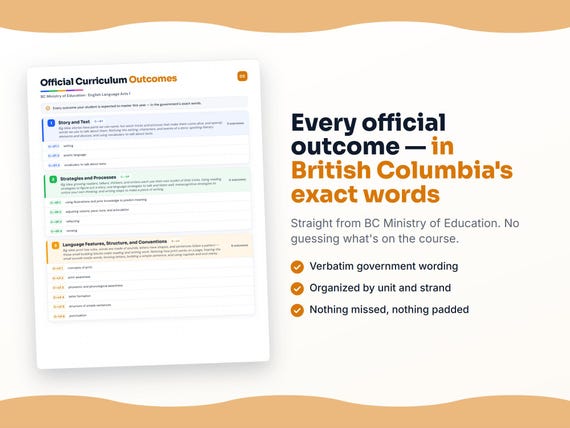
British Columbia defines English Language Arts 1 by strands and outcomes. MapleMind teaches the same curriculum reorganized for one-skill-at-a-time tutoring — the table shows exactly where every official strand lands, and the ministry's own wording is quoted under each unit below.
Official source BC's official English language arts curriculumRead it on the government site — curriculum.gov.bc.ca ↗| Official strand | Outcomes | Where MapleMind teaches it |
|---|---|---|
| Content — Story and Text | 10 | Story and Text |
| Content — Strategies and Processes | 21 | Strategies and Processes |
| Content — Language Features, Structure, and Conventions | 7 | Language Features, Structure, and Conventions |
Every skill below, taught one on one.
 Try the first session free
How MapleMind teaches English Language Arts 1 — every unit, lesson, and skill
Every skill below runs as a short session: a plain-words lesson, a worked example, solving it together, then a five-question skill check that earns up to three stars. Guided Mode keeps it teaching instead of answer-handing — turning it off needs a parent's password.
Unit 1Story and TextOfficial strand · Content — Story and Text
Big Idea: stories have parts we can name, fun word-tricks and pictures that make them come alive, and special words we use to talk about them. Noticing the setting, characters, and events of a story; spotting literary elements and devices; and using vocabulary to talk about texts.
What Is Inside a Story
- Where and when a story happens1.ES.1 — Point to the setting of a story — where and when it happens, like a forest at night or a kitchen in the morning.
- Who a story is about1.ES.2 — Name the character in a story — the person or animal the story is about.
- What happens in a story1.ES.3 — Tell one thing that happens in a story, in the order it happened.
Fun Words and Pictures in Stories
- Words that sound nice together1.LED.1 — Notice special, sing-song words in a poem or story, like "wiggle-waggle" or "pitter-patter", that sound fun to say.
- Pretend words that paint a picture1.LED.2 — Notice a fun pretend description, like "the leaves danced," and know it is not really true but helps you picture it.
- Rhymes and repeating sounds1.LED.3 — Spot rhyming words and repeating sounds in a story or rhyme, like "cat, hat, sat".
- Pictures that add to the story1.LED.4 — Look at a picture in a book and point to something it shows that the words did not say.
- Colours that show a feeling1.LED.5 — Notice a colour used in a picture, like dark grey clouds, and say how it makes the story feel.
- Pictures that stand for an idea1.LED.6 — Notice a picture that stands for something else, like a heart standing for love or a sun standing for a happy day.
Words We Use to Talk About Books
The official wording — 10 outcomes in this unit
- 1.ES.1
setting
- 1.ES.2
character
- 1.ES.3
events
- 1.LED.1
poetic language
- 1.LED.2
figurative language
- 1.LED.3
sound play
- 1.LED.4
images
- 1.LED.5
colour
- 1.LED.6
symbols
- 1.VOC.1
vocabulary to talk about texts
Unit 2Strategies and ProcessesOfficial strand · Content — Strategies and Processes
Big Idea: growing readers, talkers, thinkers, and writers each use their own toolkit of little tricks. Using reading strategies to figure out a story, oral language strategies to talk and listen well, metacognitive strategies to notice your own thinking, and writing steps to make a piece of writing.
Ways to Figure Out a Story
- Guessing from pictures1.RS.1 — Look at a picture and what you already know to guess what a word or the story might mean.
- Reading it again1.RS.2 — Read a sentence again when it did not make sense the first time.
- Telling the story back in my own words1.RS.3 — Tell a story back to someone using your own words instead of the book's exact words.
- Finding the big idea and small clues1.RS.4 — Point to what a short story is mostly about, and find one small detail that goes with it.
- Sounding out a word1.RS.5 — Use letter sounds and patterns you know, like "sh" or "at", to sound out a word you have not seen before.
- Words I just know by looking1.RS.6 — Recognize a familiar or "sight" word right away, without needing to sound it out, like "the" or "was".
- Checking that reading makes sense1.RS.7 — Keep checking while you read that the words are making sense, not just saying sounds.
- Fixing a reading mistake1.RS.8 — Notice when you read a word wrong and fix it yourself, without being told.
Talking and Listening in a Group
- Using a voice others can hear and understand1.OL.1 — Talk with a voice that is loud enough, at a good speed, and clear enough for others to understand.
- Looking and listening to the speaker1.OL.2 — Look at and listen to whoever is talking, instead of looking away or thinking about something else.
- Waiting for my turn to talk1.OL.3 — Wait for your turn to talk in a circle or with a partner instead of talking over someone.
- Asking a question about the topic1.OL.4 — Ask a question that matches what the group is talking about.
- Telling how it reminds me of my own life1.OL.5 — Share how something in a story or discussion reminds you of your own life, like your pet or your family.
- Adding an idea that fits the discussion1.OL.6 — Add an idea to a group talk that fits what everyone is already talking about.
Thinking About My Own Thinking
- Thinking back on what I did1.MC.1 — Think back after a story or activity and say one thing you noticed or did.
- Asking myself "does this make sense?"1.MC.2 — Ask yourself a question like "does this make sense?" while you are reading or listening.
- Picking something to get better at1.MC.3 — Pick one small thing you want to get better at, like reading a tricky word or writing neater letters.
- Checking my own work1.MC.4 — Look at your own work, like a drawing or a written word, and say one thing you did well.
Making My Writing Better
- Adding or changing an idea1.WP.1 — Add or change an idea in your writing or drawing, like adding another detail to your picture story.
- Fixing letters and spaces1.WP.2 — Check your writing for a missing capital letter, space, or end mark, and fix it.
- Thinking about who will read it1.WP.3 — Think about who will read or hear your writing, like a friend or a grown-up, before you share it.
The official wording — 21 outcomes in this unit
- 1.RS.1
using illustrations and prior knowledge to predict meaning
- 1.RS.2
rereading
- 1.RS.3
retelling in own words
- 1.RS.4
locating the main idea and details
- 1.RS.5
using knowledge of language patterns and phonics to decode words
- 1.RS.6
identifying familiar and "sight" words
- 1.RS.7
monitoring
- 1.RS.8
self-correcting errors
- 1.OL.1
adjusting volume, pace, tone, and articulation
- 1.OL.2
focusing on the speaker
- 1.OL.3
taking turns
- 1.OL.4
asking questions related to the topic
- 1.OL.5
making personal connections
- 1.OL.6
making relevant contributions to discussion
- 1.MC.1
reflecting
- 1.MC.2
questioning
- 1.MC.3
goal setting
- 1.MC.4
self-evaluating
- 1.WP.1
revising
- 1.WP.2
editing
- 1.WP.3
considering audience
Unit 3Language Features, Structure, and ConventionsOfficial strand · Content — Language Features, Structure, and Conventions
Big Idea: print has rules, words are made of sounds, letters have shapes, and sentences follow a pattern — these small building blocks make reading and writing work. Noticing how print works on a page, hearing the small sounds inside words, forming letters, building a simple sentence, and using capitals and end marks.
Where to Start, Which Way to Go
- Where reading starts and which way it goes1.COP.1 — Know that we read the words (not just the pictures), starting at the top left and going left to right, top to bottom, turning pages in order.
Noticing Letters, Words, and Spaces
- Letters, words, and spaces1.PA.1 — Notice that print is made of letters grouped into words, with a space between each word.
Playing with the Sounds in Words
- Hearing the small sounds in words1.PPA.1 — Hear and play with the sounds inside spoken words — clap syllables, hear rhymes, and blend sounds together, like c-a-t into "cat".
Shaping Our Letters
- Making each letter the right way1.LF.1 — Form each upper- and lower-case letter starting in the right place and moving the right way, so it is easy for others to read.
Building a Sentence
- What makes a simple sentence1.SS.1 — Put words in an order that makes sense, telling who or what and then what happened, to build a simple sentence.
Capitals and End Marks
- Ending a sentence with a mark1.CV.1 — Put a period or question mark at the end of a sentence you write.
- Starting with a capital letter1.CV.2 — Start every sentence you write with a capital letter.
The official wording — 7 outcomes in this unit
- 1.COP.1
concepts of print
- 1.PA.1
print awareness
- 1.PPA.1
phonemic and phonological awareness
- 1.LF.1
letter formation
- 1.SS.1
structure of simple sentences
- 1.CV.1
punctuation
- 1.CV.2
capitalization
Printable workbook · A keepsake of the year
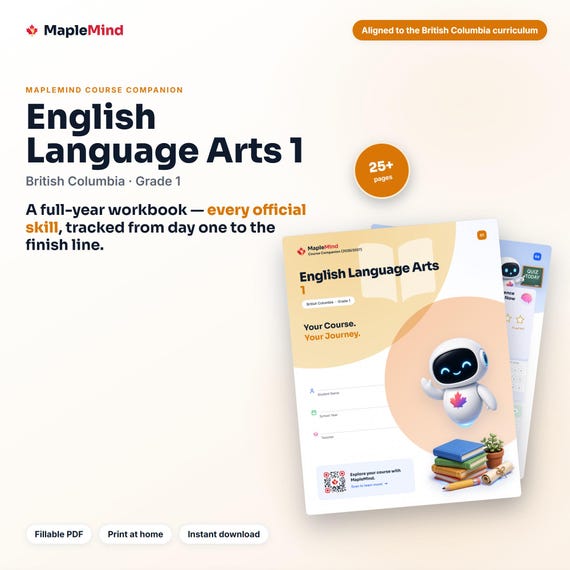
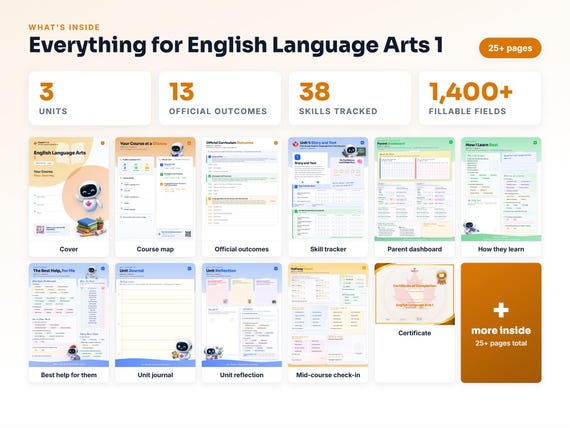
A English Language Arts 1 workbook worth keeping
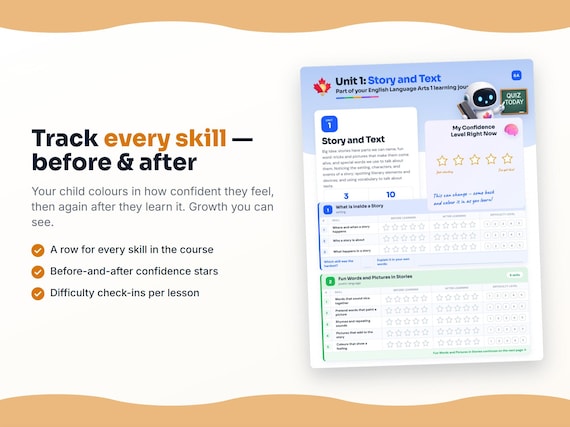
Built from the same official curriculum as this page. Before and after each skill above, your student colours in how sure they feel — so the two of you can see, on one page, what's clicking and what needs another look. It's a quiet way to follow how the year is really going.
By June it's full of their own handwriting: units worked through, confidence grown, a mid-year check-in, notes from parent-teacher night, and a certificate at the end. Less a worksheet, more a record of the year worth keeping on the shelf.
Instant download · see every page, reviews and the full description · five or more workbooks are $2.99 each
What it looks like in the app



Common questions
Can MapleMind help my child with English Language Arts 1?
Yes. MapleMind's AI tutor covers all 38 skills in British Columbia's English Language Arts 1 — your child picks the exact skill, and the tutor teaches it step by step: a short lesson, a worked example, solving together, then a skill check to show it stuck.
Is MapleMind aligned to British Columbia's official curriculum?
Yes. Every skill in this course maps to an official outcome code from British Columbia's Grade 1 English Language Arts curriculum, and the ministry's own wording is quoted under each unit on this page — with the official government source linked so you can check it yourself.
What does MapleMind cost?
It's free to start — 5 tutoring chats and a practice quiz every day, no credit card. A Pro subscription ($9.99/month or $49.99/year CAD, 7-day free trial) unlocks unlimited tutoring, practice, and exam simulations.
What if my child is stuck on just one topic?
That's the point of skill-level tutoring: open English Language Arts 1 in the app, tap the exact skill from the list on this page, and the tutor teaches just that — no wading through lessons your child doesn't need.
Does MapleMind work in French or other languages?
Yes — 14 languages, including French. Both the app and the tutor's explanations switch to the language your child chooses.
Where can I see the official British Columbia curriculum for English Language Arts 1?
The official source is linked on this page — BC's official English language arts curriculum. The outline here follows it: every MapleMind skill carries its official outcome code, and the ministry's own wording is quoted under each unit.
Keep exploring
Ready when you are
Pick a skill from this page and see it taught properly — free, in the browser, in under a minute.