Get help with French as a Second Language (CEFR A1–C2)
Most tutoring makes you sit through material you already know. MapleMind flips that: pick the exact skill that's causing trouble — any of the 30 below — and the tutor teaches just that one, step by step, as many times as it takes. Ask questions in plain words, any time of day, in English, French, or 12 other languages.
The official Alberta French as a Second Language (CEFR A1–C2) curriculum
Alberta defines French as a Second Language (CEFR A1–C2) by strands and outcomes. MapleMind teaches the same curriculum reorganized for one-skill-at-a-time tutoring — the table shows exactly where every official strand lands, and the ministry's own wording is quoted under each unit below.
Official source Alberta's official programs of studyRead it on the government site — alberta.ca ↗| Official strand | Outcomes | Where MapleMind teaches it |
|---|---|---|
| CEFR A1 | 5 | A1 — Breakthrough (Beginner) |
| CEFR A2 | 5 | A2 — Waystage (Elementary) |
| CEFR B1 | 5 | B1 — Threshold (Intermediate) |
| CEFR B2 | 5 | B2 — Vantage (Upper Intermediate) |
| CEFR C1 | 5 | C1 — Effective Operational Proficiency (Advanced) |
| CEFR C2 | 5 | C2 — Mastery (Proficient) |
Every skill below, taught one on one.
 Try the first session free
How MapleMind teaches French as a Second Language (CEFR A1–C2) — every unit, lesson, and skill
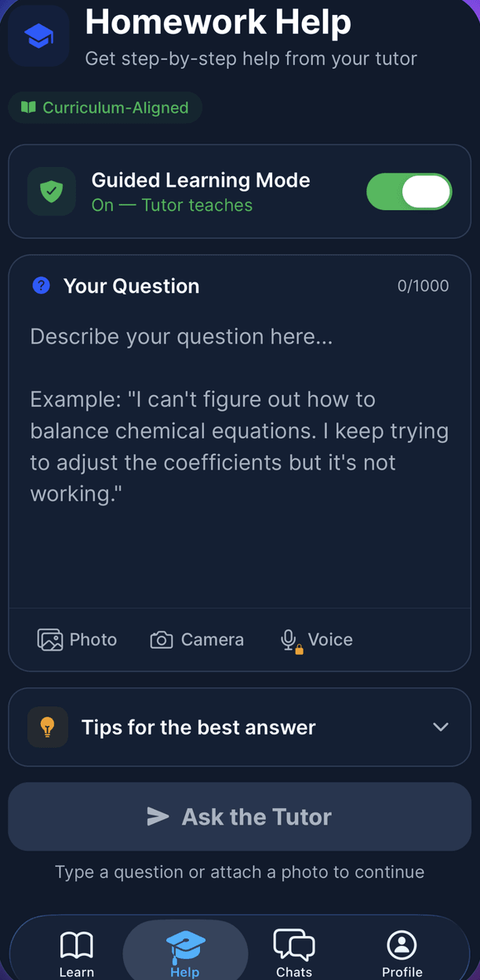
Every skill below runs as a short session: a plain-words lesson, a worked example, solving it together, then a five-question skill check that earns up to three stars. Guided Mode keeps it teaching instead of answer-handing — turning it off needs a parent's password.
Unit 1A1 — Breakthrough (Beginner)Official strand · CEFR A1
The first rung: introduce yourself, greet people, and handle very simple, slow, supported exchanges about yourself and your immediate surroundings.
A1 — First Contact in French
- A1 — ListeningA1.L — Recognize familiar French words and very basic phrases about myself, my family, and my immediate surroundings when people speak slowly and clearly.
- A1 — ReadingA1.R — Understand familiar names, words, and very simple French sentences on signs, posters, and in catalogues.
- A1 — Spoken InteractionA1.SI — Interact in a simple way when the other person speaks slowly and helps me — asking and answering simple questions on very familiar topics.
- A1 — Spoken ProductionA1.SP — Use simple phrases and sentences to describe where I live and people I know.
- A1 — WritingA1.W — Write a short, simple postcard and fill in forms with personal details (name, nationality, address).
The official wording — 5 outcomes in this unit
- A1.L
I can recognise familiar words and very basic phrases concerning myself, my family and immediate concrete surroundings when people speak slowly and clearly.
- A1.R
I can understand familiar names, words and very simple sentences, for example on notices and posters or in catalogues.
- A1.SI
I can interact in a simple way provided the other person is prepared to repeat or rephrase things at a slower rate of speech and help me formulate what I'm trying to say.
- A1.SP
I can use simple phrases and sentences to describe where I live and people I know.
- A1.W
I can write a short, simple postcard, for example sending holiday greetings.
Unit 2A2 — Waystage (Elementary)Official strand · CEFR A2
Handle everyday routines: understand high-frequency language about personal and family matters, shopping, and local life, and describe your background in simple terms.
A2 — Everyday French
- A2 — ListeningA2.L — Understand high-frequency French about areas of immediate relevance (personal/family info, shopping, local area, work) and catch the point of short, clear messages.
- A2 — ReadingA2.R — Read short, simple texts and find predictable information in everyday material like ads, menus, and timetables.
- A2 — Spoken InteractionA2.SI — Communicate in simple, routine exchanges of information on familiar topics and handle very short social exchanges.
- A2 — Spoken ProductionA2.SP — Use a series of phrases to describe, in simple terms, my family, living conditions, education, and job.
- A2 — WritingA2.W — Write short, simple notes and messages, and a very simple personal letter (e.g. a thank-you).
The official wording — 5 outcomes in this unit
- A2.L
I can understand phrases and the highest frequency vocabulary related to areas of most immediate personal relevance (e.g. very basic personal and family information, shopping, local area, employment).
- A2.R
I can find specific, predictable information in simple everyday material such as advertisements, prospectuses, menus and timetables
- A2.SI
I can communicate in simple and routine tasks requiring a simple and direct exchange of information on familiar topics and activities.
- A2.SP
I can use a series of phrases and sentences to describe in simple terms my family and other people, living conditions, my educational background and my present or most recent job.
- A2.W
I can write short, simple notes and messages relating to matters in areas of immediate needs.
Unit 3B1 — Threshold (Intermediate)Official strand · CEFR B1
Cope independently: follow clear standard speech on familiar matters, get by while travelling, and connect ideas to tell stories and describe experiences and plans.
B1 — Getting By on Your Own
- B1 — ListeningB1.L — Understand the main points of clear standard French on familiar matters from work, school, and leisure.
- B1 — ReadingB1.R — Understand texts made up mainly of high-frequency everyday or job-related French, including feelings and wishes in personal letters.
- B1 — Spoken InteractionB1.SI — Deal with most situations that come up while travelling where French is spoken, and enter unprepared into conversation on familiar topics.
- B1 — Spoken ProductionB1.SP — Connect phrases to describe experiences, dreams, and ambitions, and briefly give reasons for opinions and plans.
- B1 — WritingB1.W — Write simple connected text on familiar topics and personal letters describing experiences and impressions.
The official wording — 5 outcomes in this unit
- B1.L
I can understand the main points of clear standard speech on familiar matters regularly encountered in work, school, leisure, etc.
- B1.R
I can understand texts that consist mainly of high frequency everyday or job-related language.
- B1.SI
I can deal with most situations likely to arise whilst travelling in an area where the language is spoken.
- B1.SP
I can connect phrases in a simple way in order to describe experiences and events, my dreams, hopes and ambitions.
- B1.W
I can write simple connected text on topics which are familiar or of personal interest.
Unit 4B2 — Vantage (Upper Intermediate)Official strand · CEFR B2
Operate with fluency: follow complex argument and most news/films, interact spontaneously with native speakers, and write clear, detailed text and argument.
B2 — Fluency & Detail
- B2 — ListeningB2.L — Understand extended speech and lectures and follow complex argument on reasonably familiar topics; understand most TV news and films in standard dialect.
- B2 — ReadingB2.R — Read articles and reports on contemporary problems where writers take particular positions, and understand contemporary literary prose.
- B2 — Spoken InteractionB2.SI — Interact with enough fluency and spontaneity to make regular interaction with native speakers quite possible, taking an active part in familiar discussion.
- B2 — Spoken ProductionB2.SP — Present clear, detailed descriptions on a wide range of topics in my field and explain a viewpoint with pros and cons.
- B2 — WritingB2.W — Write clear, detailed text on a wide range of subjects and an essay or report arguing for or against a point of view.
The official wording — 5 outcomes in this unit
- B2.L
I can understand extended speech and lectures and follow even complex lines of argument provided the topic is reasonably familiar.
- B2.R
I can read articles and reports concerned with contemporary problems in which the writers adopt particular attitudes or viewpoints.
- B2.SI
I can interact with a degree of fluency and spontaneity that makes regular interaction with native speakers quite possible.
- B2.SP
I can present clear, detailed descriptions on a wide range of subjects related to my field of interest.
- B2.W
I can write clear, detailed text on a wide range of subjects related to my interests.
Unit 5C1 — Effective Operational Proficiency (Advanced)Official strand · CEFR C1
Use French flexibly and effectively: follow implicit meaning, read long complex texts, express yourself fluently, and structure clear, detailed writing.
C1 — Flexible & Precise
- C1 — ListeningC1.L — Understand extended speech even when it is not clearly structured and meaning is only implied; understand TV programmes and films with little effort.
- C1 — ReadingC1.R — Understand long and complex factual and literary texts and appreciate distinctions of style; understand specialised articles and longer technical instructions.
- C1 — Spoken InteractionC1.SI — Express myself fluently and spontaneously without much obvious searching, using language flexibly for social and professional purposes.
- C1 — Spoken ProductionC1.SP — Present clear, detailed descriptions of complex subjects, integrating sub-themes and rounding off with an appropriate conclusion.
- C1 — WritingC1.W — Write clear, well-structured text expressing points of view at length, and write about complex subjects in a letter, essay, or report.
The official wording — 5 outcomes in this unit
- C1.L
I can understand extended speech even when it is not clearly structured and when relationships are only implied and not signalled explicitly.
- C1.R
I can understand long and complex factual and literary texts, appreciating distinctions of style.
- C1.SI
I can express myself fluently and spontaneously without much obvious searching for expressions.
- C1.SP
I can present clear, detailed descriptions of complex subjects integrating sub-themes, developing particular points and rounding off with an appropriate conclusion.
- C1.W
I can write about complex subjects in a letter, an essay or a report, underlining what I consider to be the salient issues.
Unit 6C2 — Mastery (Proficient)Official strand · CEFR C2
Near-native command: understand virtually everything heard or read, take part effortlessly in any conversation, and write smoothly-flowing, precisely structured text.
C2 — Toward Mastery
- C2 — ListeningC2.L — Understand any kind of spoken French, live or broadcast, even at fast native speed, with only a little time to get used to the accent.
- C2 — ReadingC2.R — Read with ease virtually all forms of written French, including abstract, structurally or linguistically complex texts and literary works.
- C2 — Spoken InteractionC2.SI — Take part effortlessly in any conversation, with good familiarity with idioms and colloquialisms, conveying finer shades of meaning precisely.
- C2 — Spoken ProductionC2.SP — Present a clear, smoothly-flowing description or argument in a style suited to the context, with a logical structure that helps the listener follow.
- C2 — WritingC2.W — Write clear, smoothly-flowing text in an appropriate style, including complex letters, reports, articles, summaries, and reviews.
The official wording — 5 outcomes in this unit
- C2.L
I have no difficulty in understanding any kind of spoken language, whether live or broadcast, even when delivered at fast native speed, provided I have some time to get familiar with the accent.
- C2.R
I can read with ease virtually all forms of the written language, including abstract, structurally or linguistically complex texts such as manuals, specialised articles and literary works.
- C2.SI
I can take part effortlessly in any conversation or discussion and have a good familiarity with idiomatic expressions and colloquialisms.
- C2.SP
I can present a clear, smoothly-flowing description or argument in a style appropriate to the context and with an effective logical structure which helps the recipient to notice and remember significant points.
- C2.W
I can write clear, smoothly-flowing text in an appropriate style.

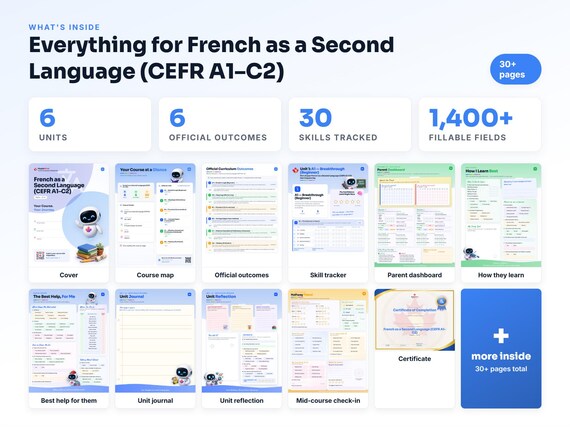
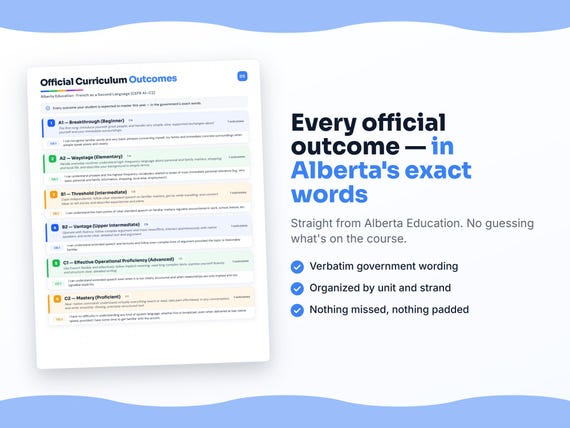
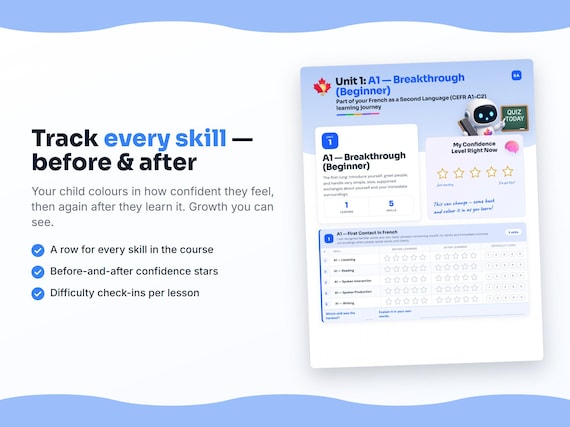
Printable workbook · A keepsake of the year
A French as a Second Language (CEFR A1–C2) workbook worth keeping
Built from the same official curriculum as this page. Before and after each skill above, your student colours in how sure they feel — so the two of you can see, on one page, what's clicking and what needs another look. It's a quiet way to follow how the year is really going.
By June it's full of their own handwriting: units worked through, confidence grown, a mid-year check-in, notes from parent-teacher night, and a certificate at the end. Less a worksheet, more a record of the year worth keeping on the shelf.
Instant download · see every page, reviews and the full description · five or more workbooks are $2.99 each
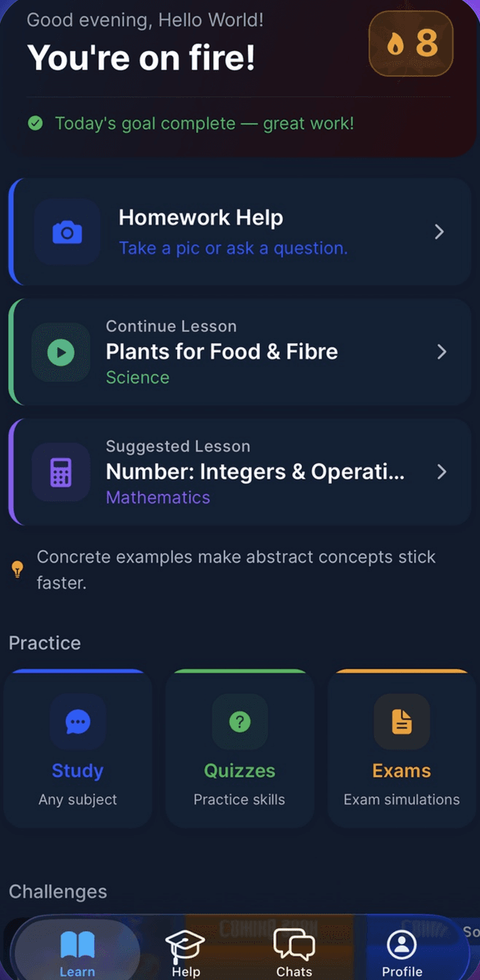
What it looks like in the app
Common questions
Can MapleMind help me with French as a Second Language (CEFR A1–C2)?
Yes. MapleMind's AI tutor covers all 30 skills in Alberta's French as a Second Language (CEFR A1–C2) — you pick the exact skill, and the tutor teaches it step by step: a short lesson, a worked example, solving together, then a skill check to show it stuck.
Is MapleMind aligned to Alberta's official curriculum?
Yes. Every skill in this course maps to an official outcome code from Alberta's A1-C2 French as a Second Language curriculum, and the ministry's own wording is quoted under each unit on this page — with the official government source linked so you can check it yourself.
What does MapleMind cost?
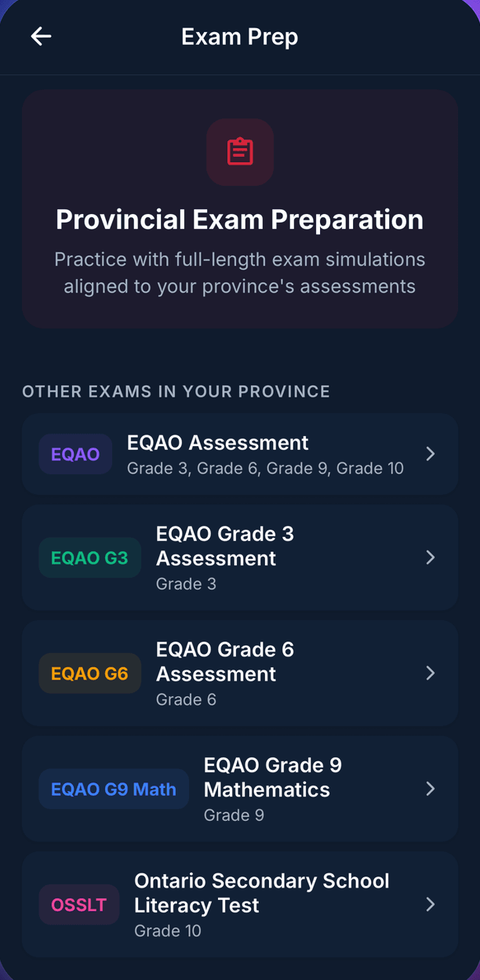
It's free to start — 5 tutoring chats and a practice quiz every day, no credit card. A Pro subscription ($9.99/month or $49.99/year CAD, 7-day free trial) unlocks unlimited tutoring, practice, and exam simulations.
What if I'm stuck on just one topic?
That's the point of skill-level tutoring: open French as a Second Language (CEFR A1–C2) in the app, tap the exact skill from the list on this page, and the tutor teaches just that — no wading through lessons you don't need.
Does MapleMind work in French or other languages?
Yes — 14 languages, including French. Both the app and the tutor's explanations switch to the language you choose.
Where can I see the official Alberta curriculum for French as a Second Language (CEFR A1–C2)?
The official source is linked on this page — Alberta's official programs of study. The outline here follows it: every MapleMind skill carries its official outcome code, and the ministry's own wording is quoted under each unit.
Ready when you are
Pick a skill from this page and see it taught properly — free, in the browser, in under a minute.