Get help with English as an Additional Language (Grades 7–9)
Most tutoring makes you sit through material you already know. MapleMind flips that: pick the exact skill that's causing trouble — any of the 28 below — and the tutor teaches just that one, step by step, as many times as it takes. Ask questions in plain words, any time of day, in English, French, or 12 other languages.
The official Alberta English as an Additional Language (Grades 7–9) curriculum
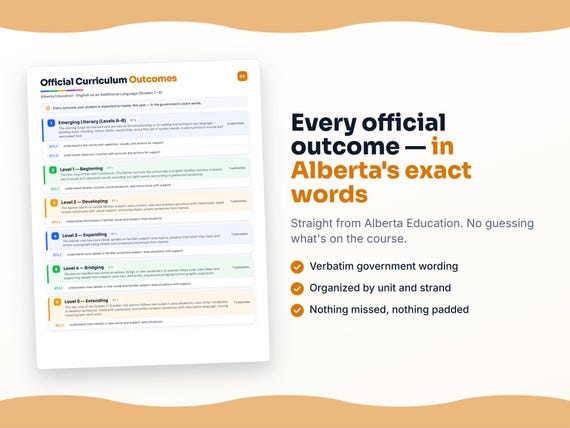
Alberta defines English as an Additional Language (Grades 7–9) by strands and outcomes. MapleMind teaches the same curriculum reorganized for one-skill-at-a-time tutoring — the table shows exactly where every official strand lands, and the ministry's own wording is quoted under each unit below.
Official source Alberta's official programs of studyRead it on the government site — alberta.ca ↗| Official strand | Outcomes | Where MapleMind teaches it |
|---|---|---|
| EAL 7–9 · Levels A & B | 8 | Emerging Literacy (Levels A–B) |
| EAL 7–9 · Level 1 | 4 | Level 1 — Beginning |
| EAL 7–9 · Level 2 | 4 | Level 2 — Developing |
| EAL 7–9 · Level 3 | 4 | Level 3 — Expanding |
| EAL 7–9 · Level 4 | 4 | Level 4 — Bridging |
| EAL 7–9 · Level 5 | 4 | Level 5 — Extending |
Every skill below, taught one on one.
 Try the first session free
How MapleMind teaches English as an Additional Language (Grades 7–9) — every unit, lesson, and skill
Every skill below runs as a short session: a plain-words lesson, a worked example, solving it together, then a five-question skill check that earns up to three stars. Guided Mode keeps it teaching instead of answer-handing — turning it off needs a parent's password.
Unit 1Emerging Literacy (Levels A–B)Official strand · EAL 7–9 · Levels A & B
The starting rungs for learners who are new to formal schooling or to reading and writing in any language — building book-handling, letters, letter–sound links, and a first set of spoken words. A silent period is normal and welcomed here.
Level A — First Words & Letters
- Level A — ListeningA.L — Understand a few high-frequency words when they are heavily supported by repetition, pictures, and gestures — leaning on the home language(s) to make meaning.
- Level A — SpeakingA.S — Repeat one or two words and show needs with actions, using the home language(s) as a bridge. A silent period is expected and fine.
- Level A — ReadingA.R — Recognize letters, connect pictures in books to familiar words, and build book-handling skills (front-to-back, top-to-bottom, page turning).
- Level A — WritingA.W — Copy letters and numbers, drawing on the home language(s) and digital tools for support.
Level B — Routines & Sounds
- Level B — ListeningB.L — Follow classroom routines when they are supported by pictures and gestures, still leaning on the home language(s) when needed.
- Level B — SpeakingB.S — Use a few memorized words and phrases to communicate basic needs, using home-language translation as a bridge.
- Level B — ReadingB.R — Read letter by letter and understand that letters relate to sounds — the start of decoding.
- Level B — WritingB.W — Copy familiar words and use memorized letters and numbers with support, drawing on the home language(s) and digital tools.
The official wording — 8 outcomes in this unit
- A.L
understand a few words with repetition, visuals, and actions for support
- A.S
repeat one or two words
- A.R
read letters, understand pictures in books related to familiar words, and develop book-handling skills
- A.W
copy letters and numbers
- B.L
understand classroom routines with pictures and actions for support
- B.S
use a few memorized words and phrases to communicate needs
- B.R
read letter by letter and understand that letters relate to sounds
- B.W
copy familiar words and use memorized letters and numbers with support
Unit 2Level 1 — BeginningOfficial strand · EAL 7–9 · Level 1
The first rung of the main continuum. The learner survives the school day in English: familiar routines, a starter set of social and classroom words, sounding out sight words, and writing in patterned sentences.
Level 1 — Everyday English
- Level 1 — Listening1.L — Follow familiar routines, everyday social situations, and simple instructions when they are supported by gestures, visuals, or repetition.
- Level 1 — Speaking1.S — Use familiar social and classroom words and phrases to share needs and ask simple questions, with support.
- Level 1 — Reading1.R — Read word by word by sounding out familiar sight words, and understand a few common words with visual support.
- Level 1 — Writing1.W — Copy familiar words and phrases and use them in patterned sentences, with a personal bilingual dictionary as support.
The official wording — 4 outcomes in this unit
- 1.L
understand familiar routines, social situations, and instructions with support
- 1.S
use familiar social and classroom words and phrases to share needs and ask questions with support
- 1.R
read word by word by sounding out familiar sight words and understand a few common words with visual support
- 1.W
copy familiar words and phrases and use in patterned sentences
Unit 3Level 2 — DevelopingOfficial strand · EAL 7–9 · Level 2
The learner starts to handle familiar subject-area content, asks and answers questions with classmates, reads simple sentences with visual support, and writes basic simple sentences from frames.
Level 2 — Simple Sentences
- Level 2 — Listening2.L — Understand information in familiar social and subject-area situations, using translation tools when needed.
- Level 2 — Speaking2.S — Use familiar words to ask and respond to questions and to speak with classmates, using translation tools as support.
- Level 2 — Reading2.R — Read and understand familiar words and simple sentences, supported by visuals and the home language(s).
- Level 2 — Writing2.W — Use familiar words and basic simple sentences with support from sentence frames.
The official wording — 4 outcomes in this unit
- 2.L
understand information in familiar social and subject-area situations
- 2.S
use familiar words to ask and respond to questions and speak with classmates
- 2.R
read and understand familiar words and simple sentences with support from visuals and home language(s)
- 2.W
use familiar words and basic simple sentences with support from sentence frames
Unit 4Level 3 — ExpandingOfficial strand · EAL 7–9 · Level 3
The learner catches more detail, speaks on familiar subject-area topics, predicts from what they read, and writes a paragraph using simple and compound sentences from frames.
Level 3 — Into Paragraphs
- Level 3 — Listening3.L — Understand more details in familiar social and subject-area situations, with support.
- Level 3 — Speaking3.S — Use familiar words to ask and answer questions and to speak on familiar subject-area topics.
- Level 3 — Reading3.R — Understand familiar words and sentences using visual supports, and use the information to predict events or next steps.
- Level 3 — Writing3.W — Use simple and familiar compound sentences in a paragraph on new topics, with support from paragraph frames.
The official wording — 4 outcomes in this unit
- 3.L
understand more details in familiar social and subject-area situations with support
- 3.S
use familiar words to ask and answer questions and speak on familiar subject-area topics
- 3.R
understand familiar words and sentences, using visual supports
- 3.W
use simple and familiar compound sentences in a paragraph on new topics with support from paragraph frames
Unit 5Level 4 — BridgingOfficial strand · EAL 7–9 · Level 4
The learner handles new social situations, brings in new vocabulary to express ideas, pulls main ideas and supporting details from subject-area text, and writes sequenced paragraphs from graphic organizers.
Level 4 — Ideas & Details
- Level 4 — Listening4.L — Understand more details in new social and familiar subject-area situations, with support.
- Level 4 — Speaking4.S — Use familiar words and some new words to express ideas and ask questions about familiar subject-area topics.
- Level 4 — Reading4.R — Understand main ideas and supporting details on familiar subject-area topics, with support.
- Level 4 — Writing4.W — Use compound sentences in sequenced paragraphs on familiar topics, creating texts with support from graphic organizers.
The official wording — 4 outcomes in this unit
- 4.L
understand more details in new social and familiar subject-area situations with support
- 4.S
use familiar words and some new words to express ideas and ask questions about familiar subject-area topics
- 4.R
understand main ideas and supporting details on familiar subject-area topics with support
- 4.W
use compound sentences in sequenced paragraphs on familiar topics
Unit 6Level 5 — ExtendingOfficial strand · EAL 7–9 · Level 5
The top rung of the Grades 7–9 ladder: the learner follows new subject-area situations, uses richer vocabulary in detailed sentences, reads with expression, and writes complex sentences with descriptive language, moving toward grade-level work.
Level 5 — Toward Grade Level
- Level 5 — Listening5.L — Understand more details in new social and subject-area situations.
- Level 5 — Speaking5.S — Use more new words in detailed sentences to express ideas about new subject-area topics.
- Level 5 — Reading5.R — Read familiar information with expression and understand new subject-area topics, with support.
- Level 5 — Writing5.W — Use complex sentences and familiar descriptive words to create texts, with support from references.
The official wording — 4 outcomes in this unit
- 5.L
understand more details in new social and subject-area situations
- 5.S
use more new words in detailed sentences to express ideas about new subject-area topics
- 5.R
read familiar information with expression and understand new subject-area topics with support
- 5.W
use complex sentences and familiar descriptive words to create texts with support from references
Printable workbook · A keepsake of the year
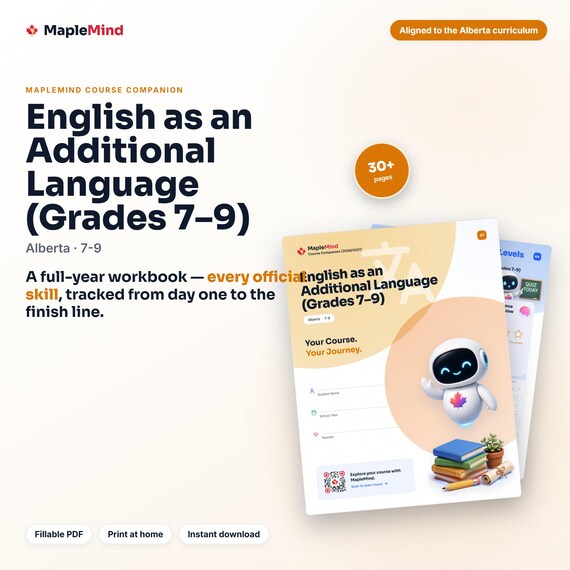
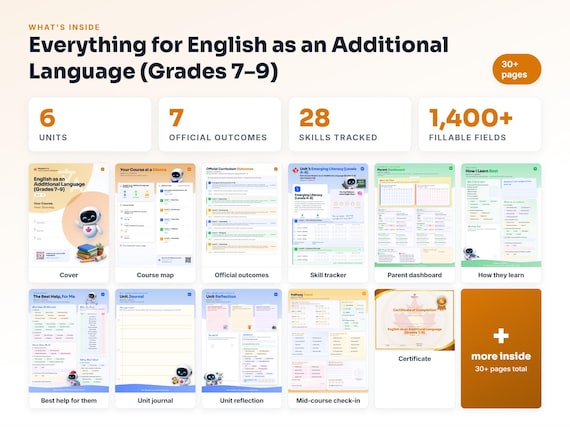
A English as an Additional Language (Grades 7–9) workbook worth keeping
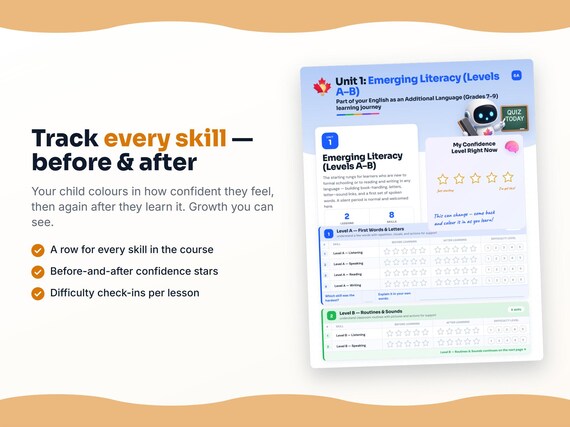
Built from the same official curriculum as this page. Before and after each skill above, your student colours in how sure they feel — so the two of you can see, on one page, what's clicking and what needs another look. It's a quiet way to follow how the year is really going.
By June it's full of their own handwriting: units worked through, confidence grown, a mid-year check-in, notes from parent-teacher night, and a certificate at the end. Less a worksheet, more a record of the year worth keeping on the shelf.
Instant download · see every page, reviews and the full description · five or more workbooks are $2.99 each
What it looks like in the app



Common questions
Can MapleMind help me with English as an Additional Language (Grades 7–9)?
Yes. MapleMind's AI tutor covers all 28 skills in Alberta's English as an Additional Language (Grades 7–9) — you pick the exact skill, and the tutor teaches it step by step: a short lesson, a worked example, solving together, then a skill check to show it stuck.
Is MapleMind aligned to Alberta's official curriculum?
Yes. Every skill in this course maps to an official outcome code from Alberta's Grades 7–9 English as an Additional Language curriculum, and the ministry's own wording is quoted under each unit on this page — with the official government source linked so you can check it yourself.
What does MapleMind cost?
It's free to start — 5 tutoring chats and a practice quiz every day, no credit card. A Pro subscription ($9.99/month or $49.99/year CAD, 7-day free trial) unlocks unlimited tutoring, practice, and exam simulations.
What if I'm stuck on just one topic?
That's the point of skill-level tutoring: open English as an Additional Language (Grades 7–9) in the app, tap the exact skill from the list on this page, and the tutor teaches just that — no wading through lessons you don't need.
Does MapleMind work in French or other languages?
Yes — 14 languages, including French. Both the app and the tutor's explanations switch to the language you choose.
Where can I see the official Alberta curriculum for English as an Additional Language (Grades 7–9)?
The official source is linked on this page — Alberta's official programs of study. The outline here follows it: every MapleMind skill carries its official outcome code, and the ministry's own wording is quoted under each unit.
Ready when you are
Pick a skill from this page and see it taught properly — free, in the browser, in under a minute.